
GE vs. DGE Spelling Rule + 5 Free Printables
This post may contain affiliate links. As an Amazon affiliate, we earn from qualifying purchases.
Learn all about the ge vs. dge long spelling rule. You’ll finally understand when to use each & gain the clarity you need to teach it effectively! Plus grab 5 free reading and spelling worksheets to help students practice and solidify this pattern.
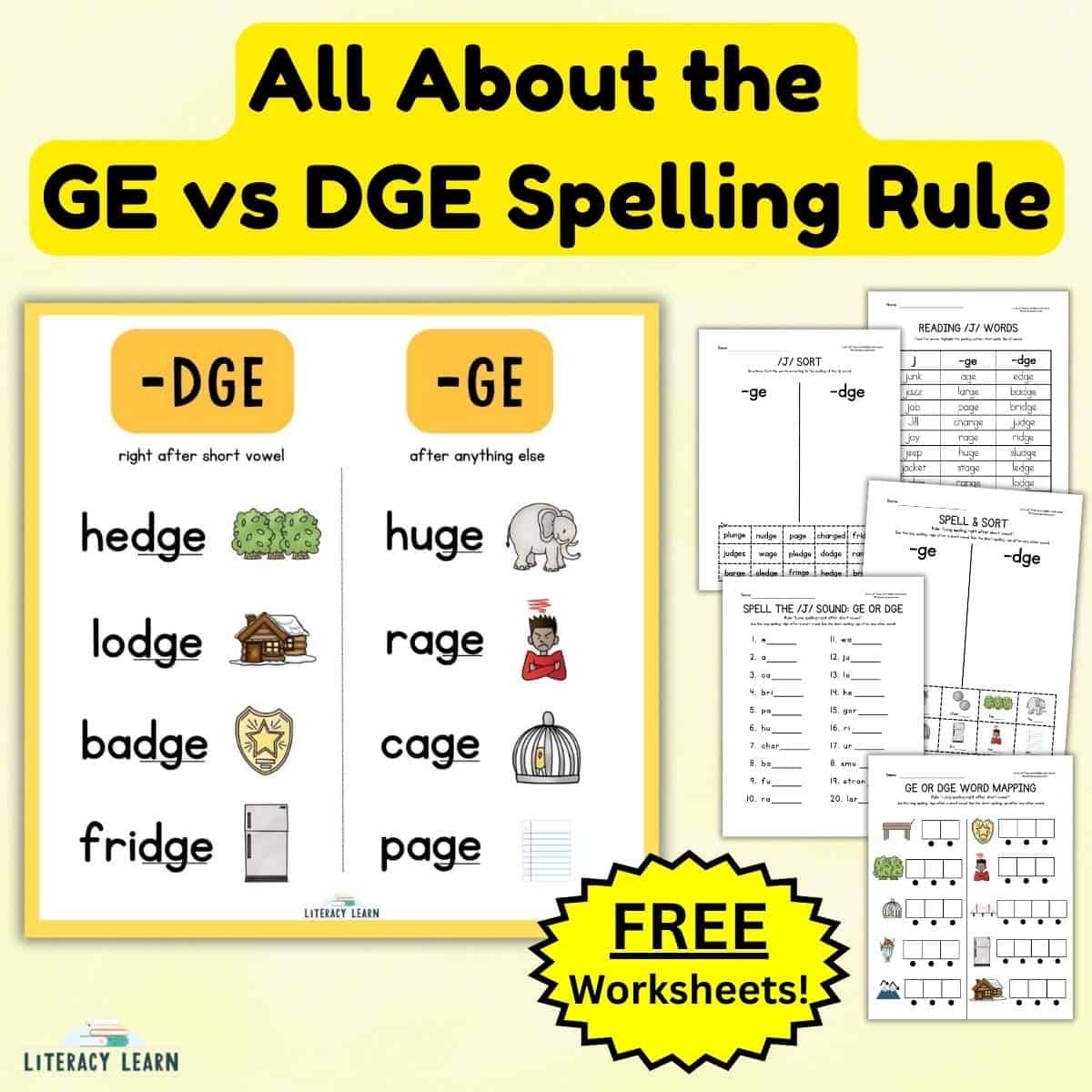
All About the /j/ Sound
In English, we have a few ways to spell the /j/ sound:
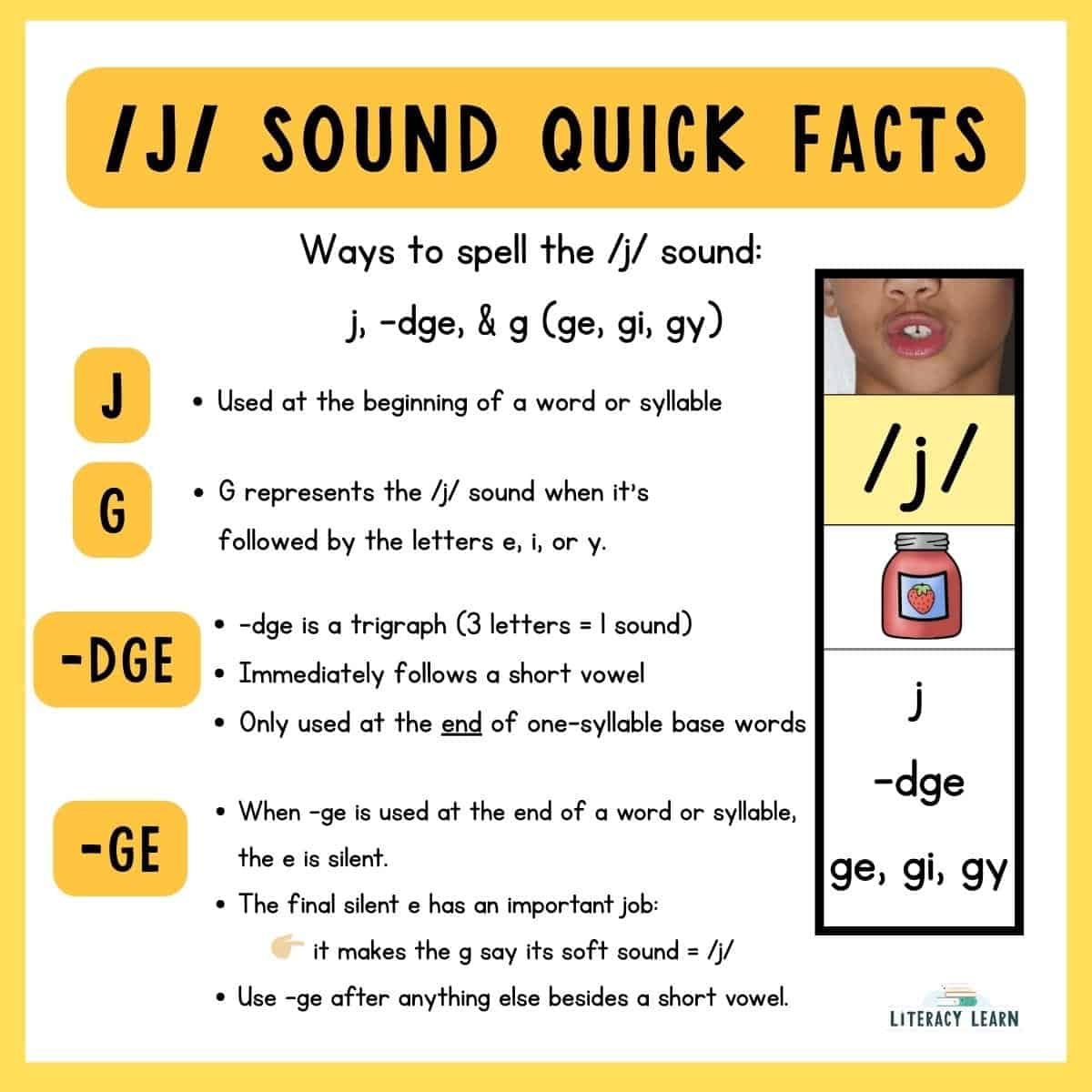
- The letter j
- The letter g (when it’s followed by an e, i, or y)
- The trigraph -dge (3 letters = one sound)
Words like jelly, gem, and edge all contain the /j/ sound, but that sound is spelled differently in each of these words.
The Letter J
The single letter grapheme J is only used at the beginning of a word or syllable. English words do NOT end in the letter J.
➡️ jam, job jack, subject, enjoy
The Letter G
G can make two sounds
- Hard /g/ as in gum
- Soft /j/ as in gem.
G usually says the /j/ sound when it’s followed by the letters e, i, or y.
💡 Read about this in our post about hard and soft g.
The Trigraph -DGE
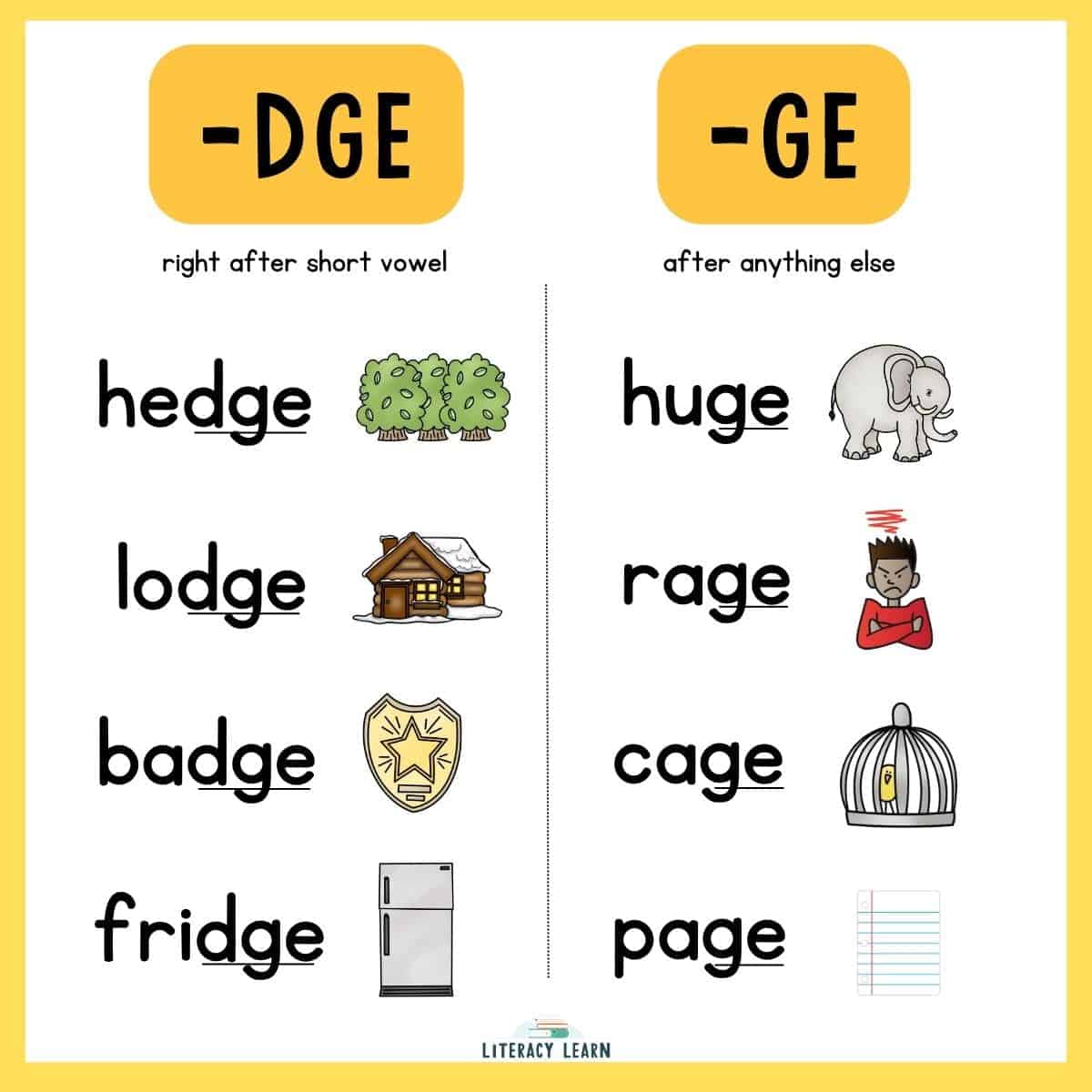
The grapheme -dge is a trigraph (3 letters = one sound). It spells the /j/ sound at the end of one-syllable base words, after a short vowel.
-GE
At the end of a word or syllable, -ge is another way to spell /j/. Even though there is an e, the e is silent. Its job is to make the g soft, so it says /j/ instead of /g/.
💡 Read our post about the many jobs of the final silent e)
The GE vs. DGE Spelling Rule
When you have multiple ways to spell the same sound, it’s super helpful when there are ‘rules’ or ‘generalizations’ for the spellings!
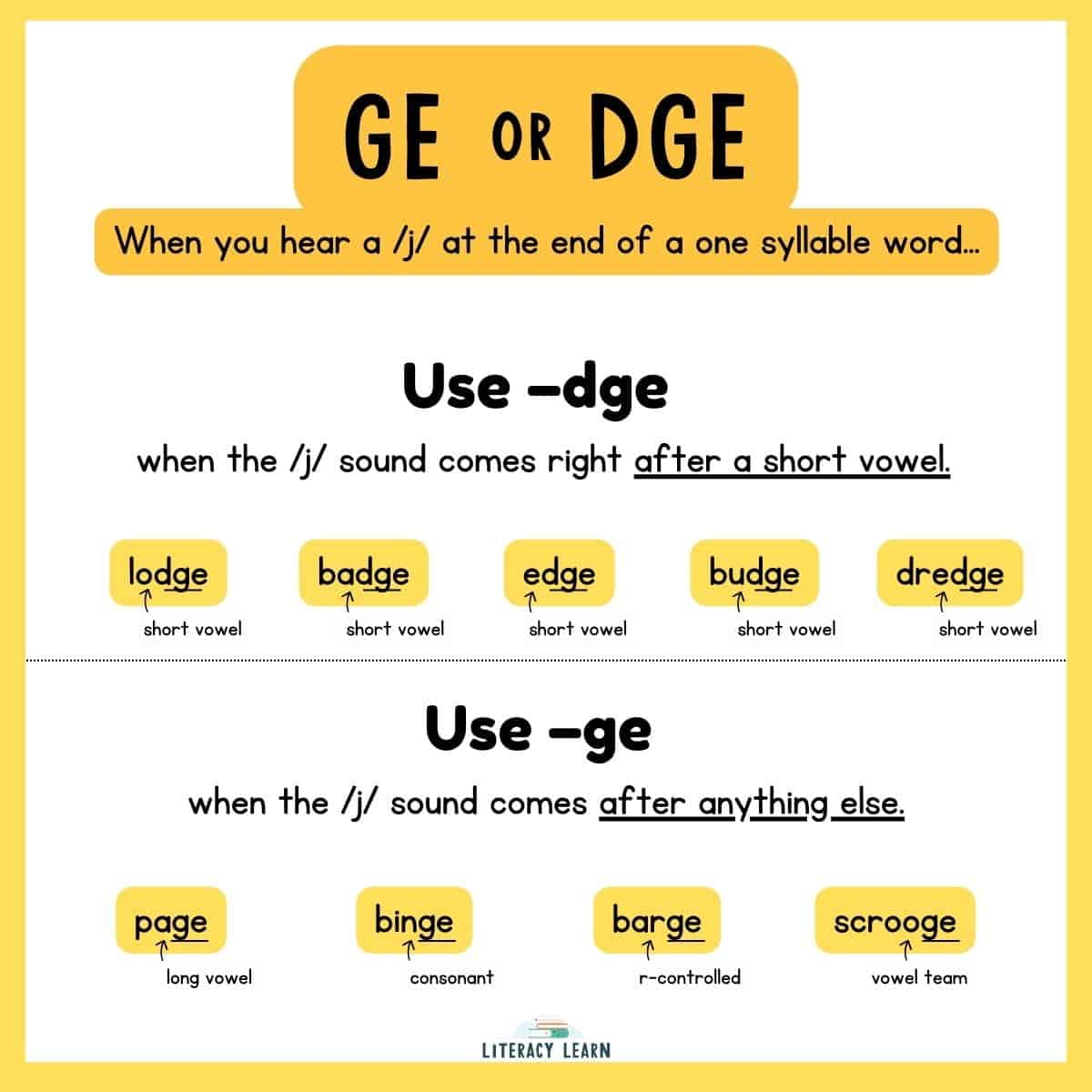
Here, we’re focusing on the rule (or generalization) for spelling the /j/ sound at the end of a word or syllable.
At The End: When you hear a /j/ at the end of a word or syllable, it can be spelled with ge or -dge.
🙋🏽♂️The big question is: How do we know which one to use?
The most important thing to pay attention to is the sound that comes right BEFORE the /j/ sound. Honing in on this sound will help you determine how to spell the /j/ sound.
📝 Rule: Use -dge immediately after a short vowel sound. Use -ge after any other sound (this can be a consonant sound or any other vowel sound e.g. long vowel, r-controlled vowel, diphthong.)
When to Use -DGE
In a one-syllable word, use -dge immediately after a short vowel sound.
–DGE Examples:
- edge
- dodge
- judge
- bridge
- fudge
⬆️ Notice how all of these words have a short vowel sound immediately before the /j/ sound. That’s why the /j/ is spelled with the trigraph -dge.
When to Use GE
In a one syllable word, use –ge after any other sound. This can be a consonant sound or any other vowel sound (e.g. long vowel, r-controlled vowel, diphthong)
GE Examples:
- age
- huge
- large
- cage
- surge
- strange
⬆️ Notice how all of these words have a consonant or another vowel sound (not short) right before the /j/ sound. That’s why the /j/ is spelled with ge.
📏 Long Spelling Rule
To help students remember this, you can use a simple jingle: “Long spelling right after short vowel.”
What does this mean? Well when you compare the graphemes, –ge has two letters while -dge has three letters.
The trigraph -dge is literally the longer way to spell the sound. That’s why this jingle makes sense, and its a fun way to make the ‘rule’ easier to remember!
👉🏻 The long spelling rule applies to other sounds, like /k/ and /ch/. Read about ch vs. tch and k vs. ck other essential spelling rules you need to teach.
Teaching Tips
Here are our best teaching tips, broken down for reading and spelling -ge and -dge words.
📑 Decoding Practice
When teaching this rule, kids need to first be aware of a few things. They need to know about the Gentle Cindy Rule and the various jobs of final silent e.
Once kids have been taught these phonics concepts, you can introduce the phonograms (ge and -dge) for reading. Use phonogram cards & add the grapheme card to your sound wall.
Students should practice reading words with both -ge and -dge, noticing the patterns.
Start with using targeted word lists and then move on to using decodable sentences and decodable texts.
🔡 Encoding Practice
Once kids can read words with both -ge and -dge rather effortlessly, it’s time to teach the long spelling rule for spelling.
Here’s the general procedure I use when students spell a word with the /j/ sound at the end:
- Students isolate the sounds in the word and draw a line for each sound they hear.
- On each line, they write one grapheme for each sound.
- They listen carefully to the sound right before the /j/.
- Students recite the jingle: “Long spelling right after short vowel.”
- If the sound before /j/ is a short vowel, they use the trigraph dge.
- If it’s anything else, they spell the /j/ sound with ge.
This type of activity works perfectly for dictation practice and helps strengthen phoneme–grapheme mapping.
▶️ Watch our video that shows you a segmenting for spelling procedure.
Dropping Rule
When explicitly teaching kids to spell the /j/ sound at the end of words, we can’t forget to include the dropping rule.
This suffix spelling rule states that when a word ends with a final silent e, we must drop the e before adding a vowel suffix. This applies to common inflectional suffixes like -ed, -es, and -ing.
- dodg
e+ ing = dodging - cag
e+ es = cages - lodge + ing = lodging
📚Learn more about this very common suffix spelling rule.
And while we’re on the topic of morphology, there’s one important thing to take note of. There is a common suffix -age that means “relating to, action.”
Teaching kids this suffix will help them when spelling two-syllable words like “package, bandage, average, manage, outage, salvage, voyage” and many more!
Free Practice Worksheets
We’re giving five free worksheets to practice reading and spelling final /j/.
For Reading (Decoding Practice)
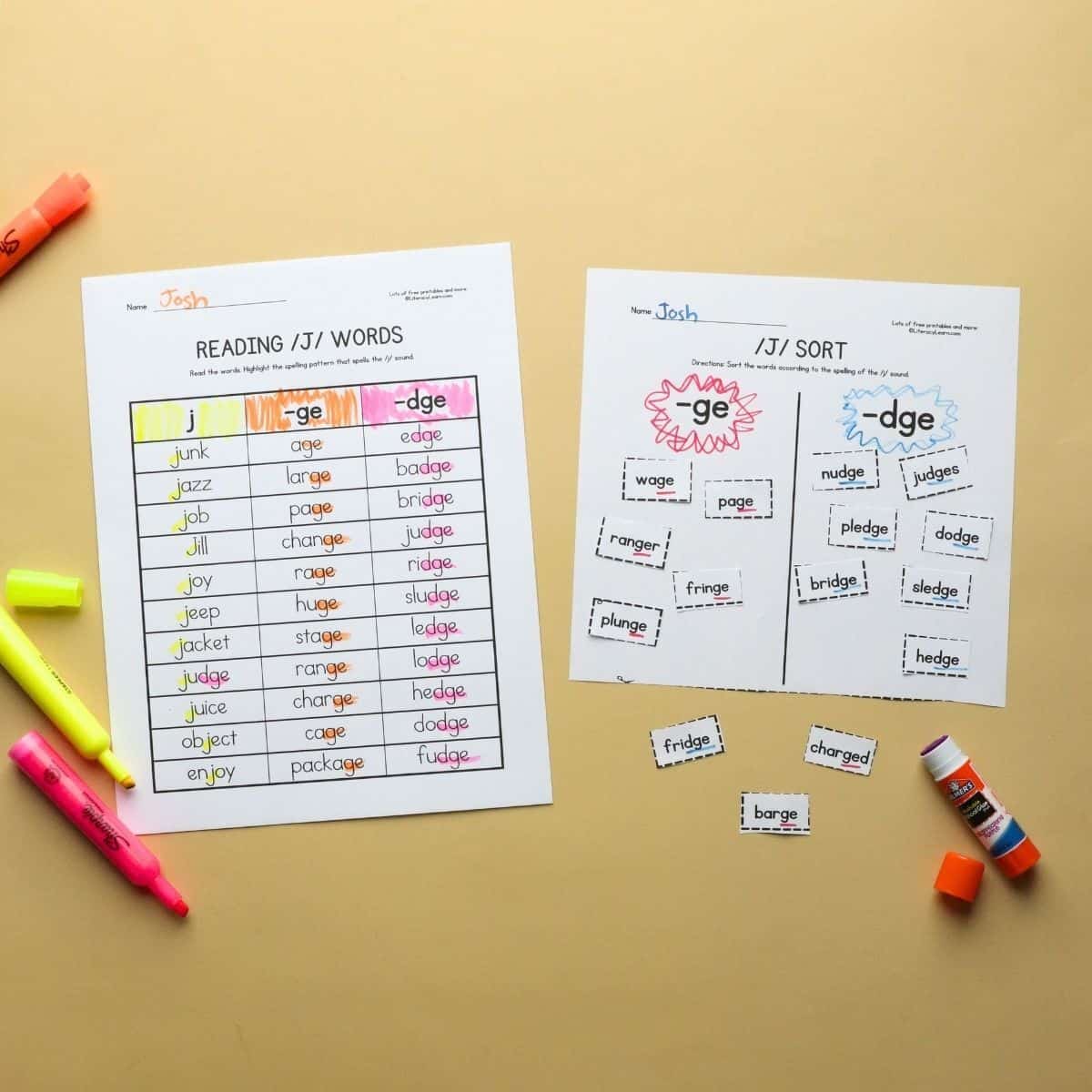
- Word List Reading Worksheet: Kids will highlight the /j/ spellings in each word. They’ll then practice reading words with -ge and -dge.
- /j/ Speling Sort Worksheet: Kids will cut out and sort the words according to the spelling of the /j/ sound.
For Spelling (Encoding Practice)
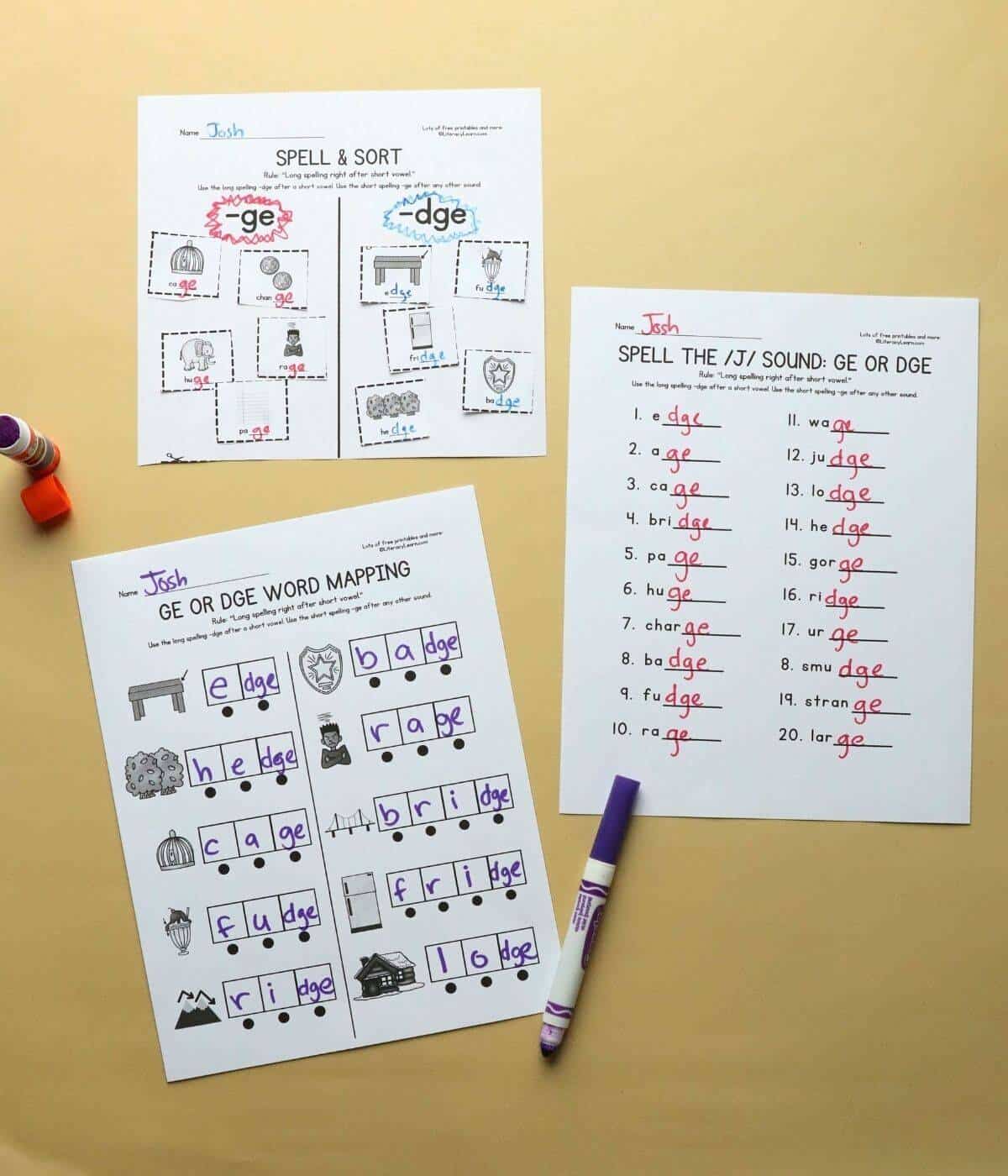
- Spell the /j/ Sound Worksheet: One syllable words are included with the initial letters written out. Kids will complete the words by spelling with either a ge or dge, applying the rule.
- Spell & Sort Worksheet: Kids will look at pictures, apply the spelling rule, and then sort words according to -ge and -dge spellings.
- Word Mapping with Sound Boxes Worksheet: Following a true speech-to-print format, kids will look at pictures and spell the words using sound boxes.
More Helpful Resources
→ Grab our ready-made Google Slides for the Long Spelling Rule!
→ Get a free printable spelling board game to make practice fun!
→ Use these phonics folders for SOR-aligned word building practice.
→ Get 32 mini-posters for all the spelling rules you need to teach. Perfect for interactive notebooks!
→ Get tons of resources for teaching inflectional suffixes (-ing, -s/es, -ing), including all the suffix spelling rules.
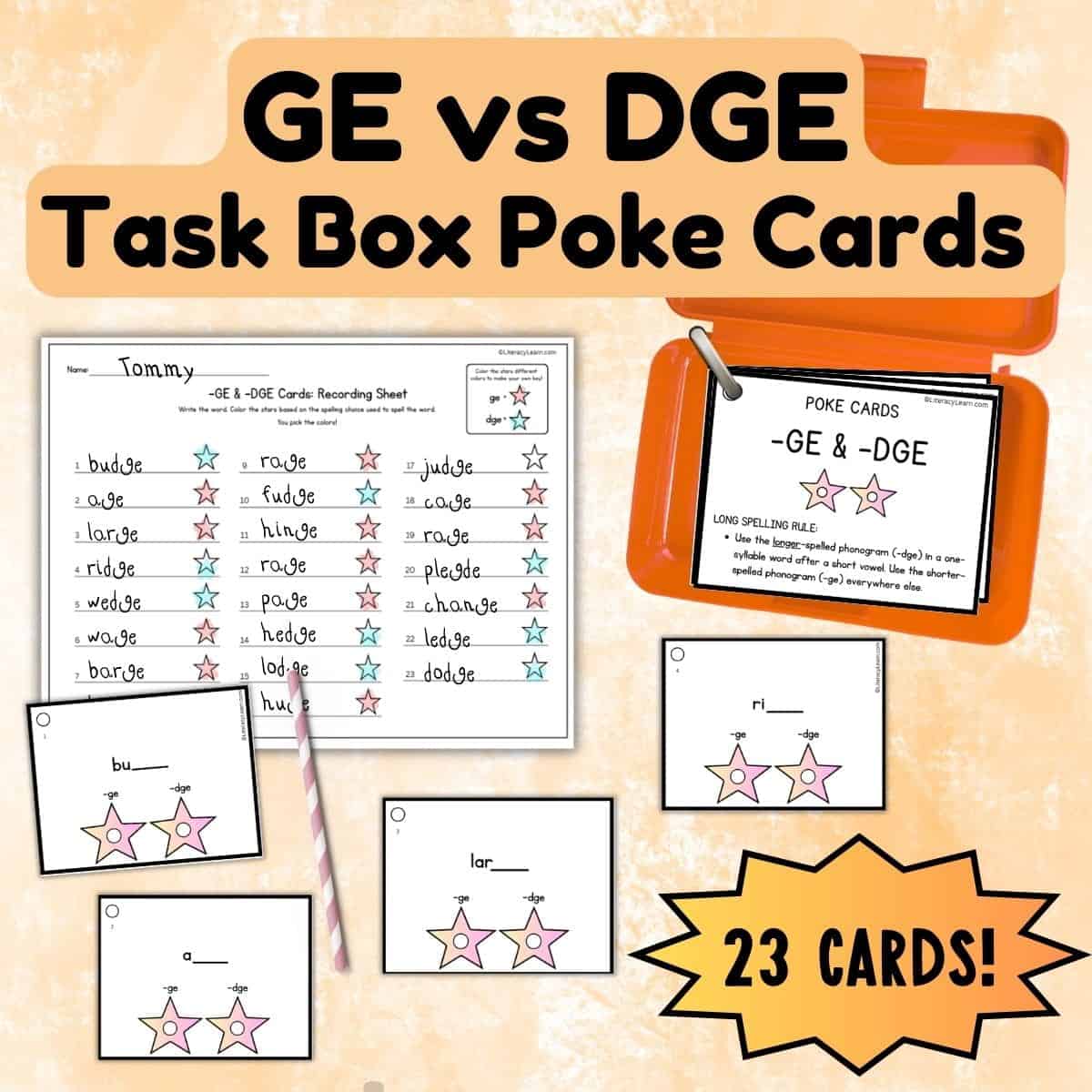
🖨️ Download & Print
DOWNLOAD TERMS: All of our resources and printables are designed for personal use only in homes and classrooms. Each teacher must download his or her own copy. You may not: Save our files to a shared drive, reproduce our resources on the web, or make photocopies for anyone besides your own students. To share with others, please use the social share links provided or distribute the link to the blog post so others can download their own copies. Your support in this allows us to keep making free resources for everyone! Please see our Creative Credits page for information about the licensed clipart we use. If you have any questions or concerns regarding our terms, please email us. Thank you!

MORE Freebies: Decoding vs. Encoding, Best Strategies for Teaching Spelling, Free Spelling Inventory
♾️ Get Unlimited SOR Printables in the members-only library!