
Frayer Model for Vocabulary with Examples & FREE Templates
This post may contain affiliate links. As an Amazon affiliate, we earn from qualifying purchases.
The Frayer Model is one of the most effective vocabulary graphic organizers for building deep word knowledge. Students explore words through examples, non-examples, illustrations, and meaningful word parts, for stronger vocabulary and reading comprehension. Learn more and get two free printable templates!!
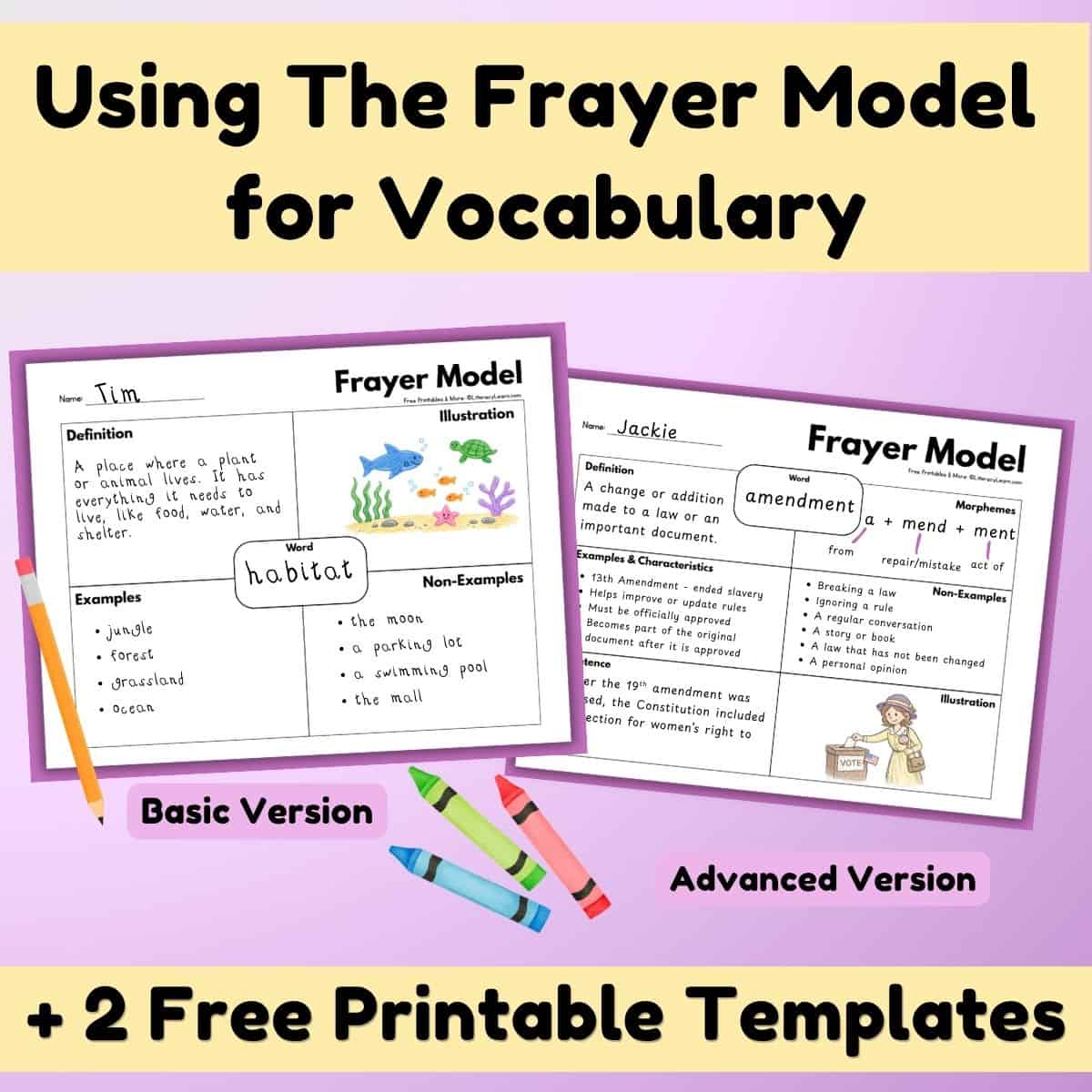
All About the Frayer Model
The Frayer Model is a graphic organizer used for explicit vocabulary instruction with the vocabulary word at its center.
It was invented in the 1960’s by Dorothy Frayer at the University of Wisconsin as a simple and effective strategy for word learning.
There are four surrounding boxes that can include any variation of the following:
- Definition
- Examples
- Non-examples,
- The word’s morphemes (meaningful word parts)
- Connected words
- An example sentence using the word
- A picture to help students connect with the word’s meaning
Adjusting the Frayer Model for Different Ages
The Frayer Model can look different depending on the age of your students.
For younger students, it can be very simple. Included might be the word, a kid-friendly definition, examples, non-examples, and a picture. This helps them understand what the word means without too much extra information.
For older students, more can be included. They might look at meaningful word parts, synonyms, antonyms, and write sentences using the word in context.
The Frayer Model can be flexible depending on your students and depending on the word.
Benefits of the Frayer Model
Many teachers rely on memorization as their primary method of teaching new vocabulary. The problem is that memorizing a definition doesn’t necessarily mean a student truly understands the word. They may still struggle to recognize the word in a passage, use it correctly in conversation or writing, or understand its meaning in different contexts.
That’s why the Frayer Model is so effective. Instead of simply memorizing definitions, students explore the word from multiple angles.
They think about the word’s characteristics, examples, non-examples, and how it’s used. This deeper processing helps them build a richer understanding of the word, making it much more likely they’ll remember it and actually use it. That’s exactly what strong vocabulary instruction should do.
Specific benefits of the Frayer Model:
- Helps make meaningful connections. “Based on our research, knowing a word’s meaning is not sufficient unless it is tied to a network of concepts” (Neuman, 2019, p. 14). By including examples, non-examples, and pictures, the Frayer Model helps kids link new words to their background knowledge.
- Supports the retention of vocabulary words. Since the Frayer Model requires students to interact and process a word in multiple ways, they’ll likely build a deeper understanding of the word so they can remember the word in the future.
- Supports morphological awareness. As students analyze the meaningful word parts (morphemes), they see the patterns in our language and can apply those patterns to unlock meaning.
- Works across grade levels and content areas. This is a flexible tool that can be used with students of all ages. Younger kids can draw pictures and share examples, while older kids can analyze morphemes and consider context. It can also be used in any subject area: math, science, social studies, or English language arts.
How to Use the Frayer Model
To use the Frayer Model with your students, follow these steps:
- Explicitly teach them what the Frayer Model is: A graphic organizer.
- Explain why it’s important: to learn new vocabulary words, deeply and permanently.
- Follow a general procedure to complete the Frayer Model activity (see below).
Remember that it’s important to explicitly teach, model, and practice the strategy together. Once students are familiar with the strategy, they can complete them in groups, pairs, or independently.
Procedure
- Pick a Word: Thoughtfully choose a word you want to explore.
- Write the Word: Write the chosen word in the center of the organizer. Pronounce it and have students repeat it.
- Define the Word: Teachers should provide a kid-friendly definition of the vocabulary word. Talk about the meaning.
- Generate examples and non-examples:* Come up with examples that fit the word and examples that do not.
- Analyze the morphemes:* Identify prefixes, bases, and suffixes and discuss how these meaningful word parts contribute to the literal definition of the word.
- Add a visual:* Students should draw a picture that helps them remember the word’s meaning.
- Use it in a sentence:* Generate a sentence with supportive context.
- Discuss the Word: Share and discuss using collaborative conversations. Revisit the word throughout the week and encourage students to use it during speaking and writing.
*These components will depend on the version of the Frayer Model you choose for students to use.
Common Frayer Model Mistakes
- Giving dictionary definitions
- Choosing words students already know
- Skipping discussion
- Treating it as a worksheet instead of instruction
- Using too many words in one lesson
Examples of the Frayer Model
We want to make it easy for you to start using the Frayer Model right away, so we’re giving you two versions: one designed for younger students and one for older students.
Basic Frayer Model (Download Free Below!)
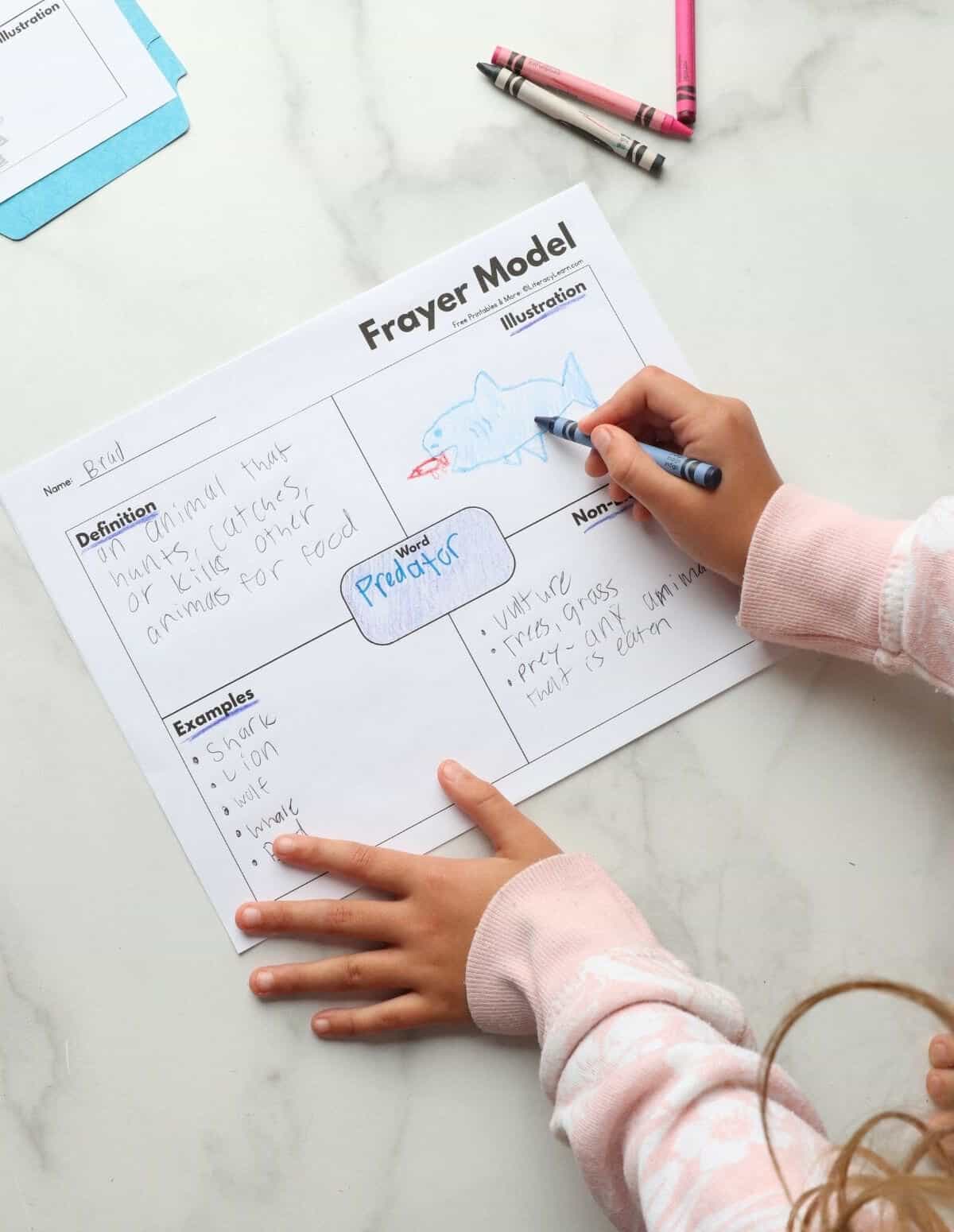
The Basic Frayer Model is perfect for younger students who are just beginning to build vocabulary. It includes four simple sections:
- Definition: Write the definition of the word in easy-to-understand terms.
- Illustration: Draw a picture that represents the word.
- Examples: List examples of the word or concept.
- Non-examples: Identify things that are not examples to deepen understanding.
Advanced Frayer Models (Download Free Below!)
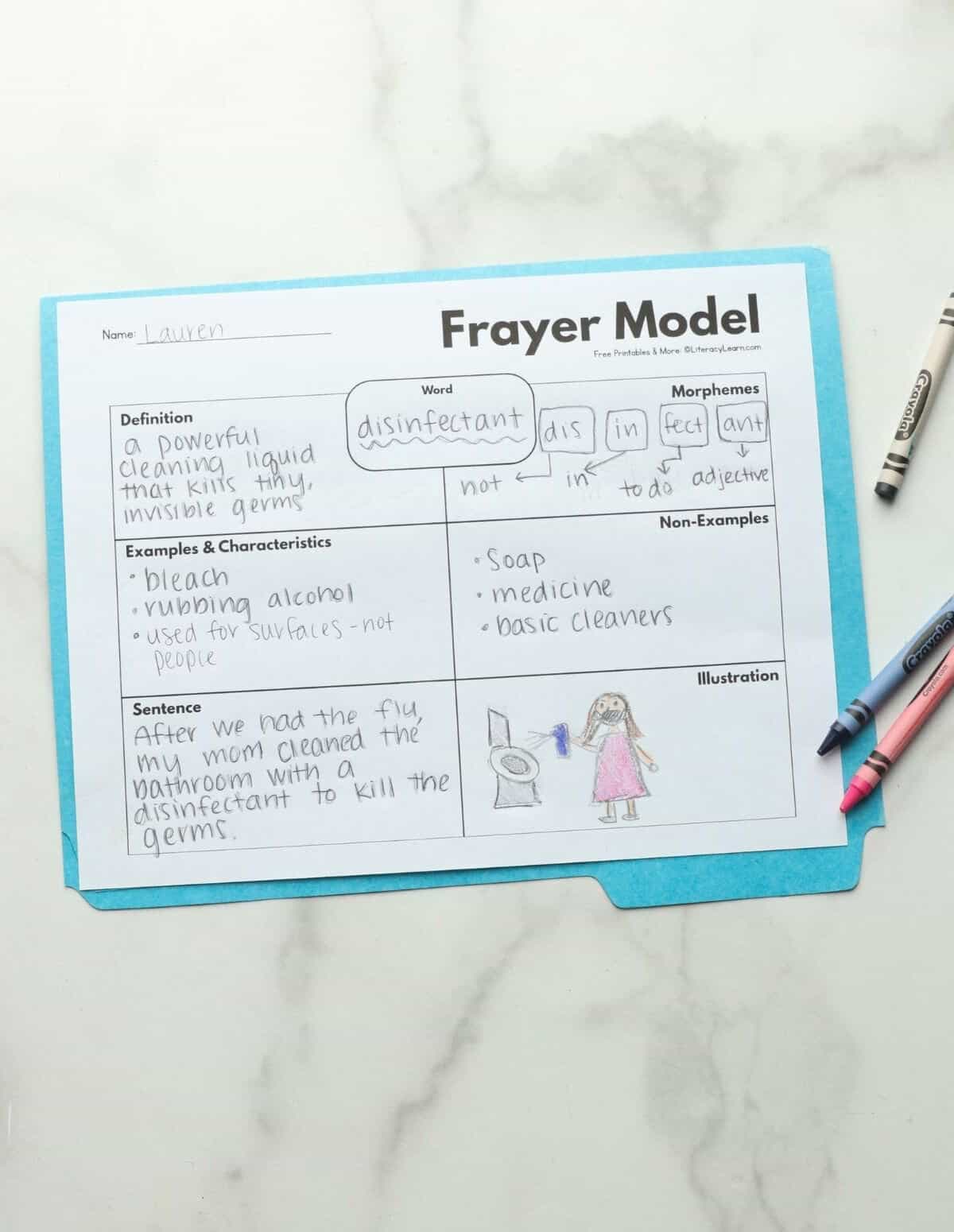
The Advanced Frayer Model is designed for older students or those ready for more in-depth vocabulary study. In addition to defining the word, students explore its structure and use it in context. It includes six sections:
- Definition: Write the definition of the word in student-friendly language.
- Morphemes: Break the word into meaningful parts (prefixes, bases, and suffixes).
- Examples/Characteristics: List examples or important features of the word.
- Non-examples
- Sentence: Use the word correctly in context.
- Illustration: Draw a visual representation of the word.
Download your free Frayer Model printables below and start building deeper vocabulary knowledge today!
Tips for Teachers
- Complete a page together first so students understand each section.
- Encourage students to think aloud while modeling.
- Keep completed models in vocabulary notebooks, and revisit the organizer throughout the week.
- Each student’s model will be slightly different! Encourage discussion!
🤩 Looking for more great ways to teach vocabulary? Check out the best vocabulary-building books, and get our free word matrix, shades of meaning anchor chart, and alphaboxes graphic organizer!
References: Neuman, S. B. (2019). Comprehension in Disguise: The Role of Knowledge in Children’s Learning. Perspectives on Language and Literacy, 45(4), 12-16. Read the full article.
🖨️ Download & Print

MORE Freebies: Semantic Mapping, Idioms Worksheet, Context Clues.
♾️ Get Unlimited SOR Printables in the members-only library!
DOWNLOAD TERMS: All of our resources and printables are designed for personal use only in homes and classrooms. Each teacher must download his or her own copy. You may not: Save our files to a shared drive, reproduce our resources on the web, or make photocopies for anyone besides your own students. To share with others, please use the social share links provided or distribute the link to the blog post so others can download their own copies. Your support in this allows us to keep making free resources for everyone! Please see our Creative Credits page for information about the licensed clipart we use. If you have any questions or concerns regarding our terms, please email us. Thank you!