
20 Most Common Suffixes: Free Printable List
This post may contain affiliate links. As an Amazon affiliate, we earn from qualifying purchases.

Just 20 suffixes account for nearly 93% of all suffixes found in English words! To be confident, fluent readers and writers, students need to learn those suffixes! Read about the most common suffixes, and then get a free printable list of the top 20 most commonly used suffixes!
What Is a Suffix?
In English, words are built from morphemes (smallest units of meaning.) These include prefixes (added at the beginning), bases (the core of the word), and suffixes (added at the end.) We combine morphemes to create longer words and shift their meaning or function.
A suffix is a word part (morpheme) added to the end of a word. Familiar examples include suffix -ing and suffix -ed. One or more suffixes can be added to form new words.
Suffixes work in different ways.
- Some change meaning (e.g. -s or -es signals more than one, as in dog → dogs).
- Some change the part of speech (e.g. -ly often turns an adjective into an adverb, as in quick → quickly.)
- Some mark tense or comparison (e.g. -ed shows past tense, as in walk → walked)
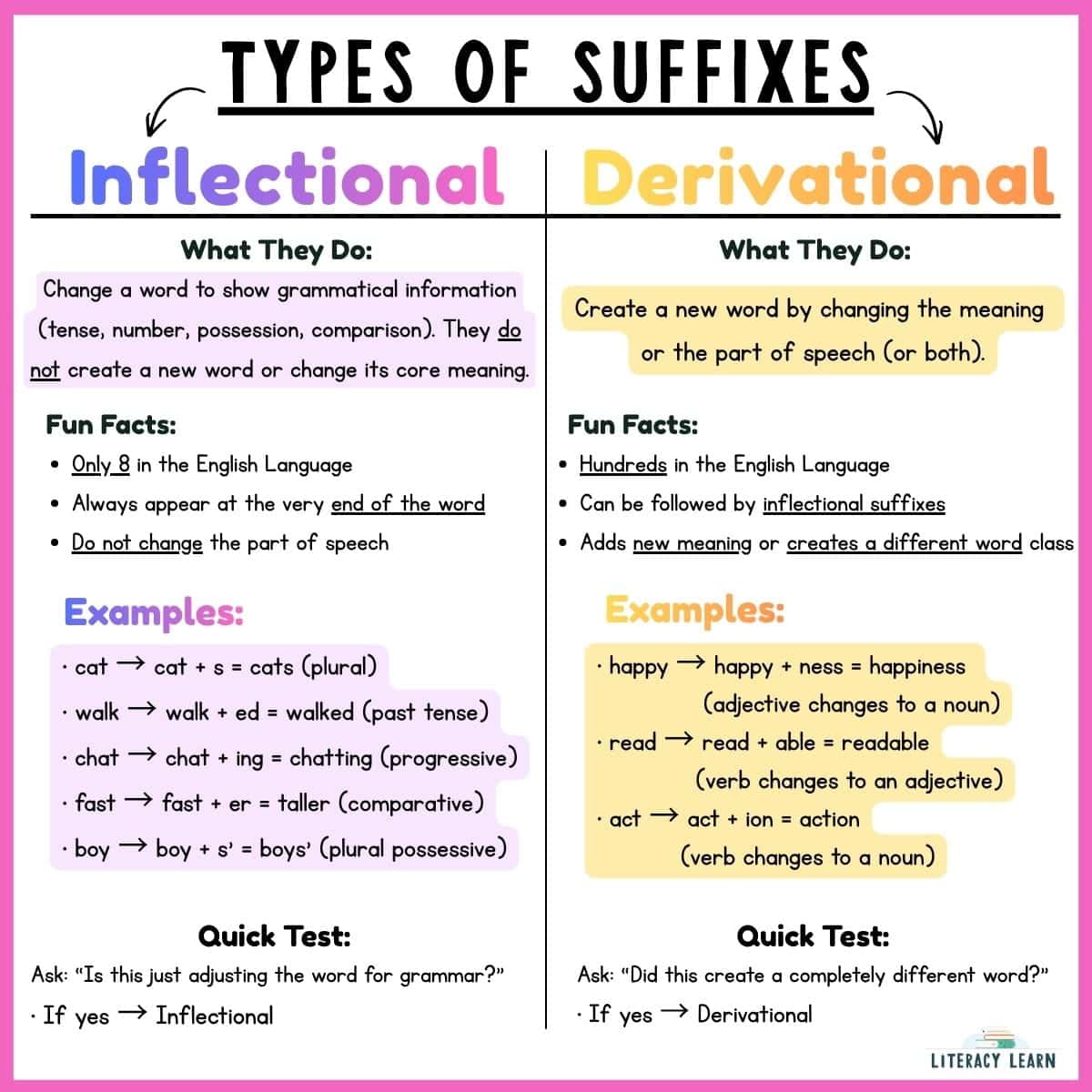
There are two types of suffixes: inflectional and derivational.
Inflectional Suffixes adjust a word’s form without creating an entirely new word. They typically signal number, tense, or degree/comparison. Common examples include:
- -s / -es (plural)
- -‘s or -s’ (possessive or plural possessive)
- -ed (past tense)
- -ing (ongoing action)
- -er (comparative)
- -est (superlative)
Derivational Suffixes create a new word by changing its meaning and/or its part of speech.
- fit → fitness (adjective to a noun)
- care → careless → carelessly (noun to adjective to adverb)
Why Teach About Suffixes?
The International Dyslexia Association has categorized morphology as an essential component of Structured Literacy. Children benefit from plenty of practice with common suffixes.
Here are some specific benefits:
Stronger Word Recognition & Decoding – When kids can recognize suffixes on words, it will help them know exactly where to break words apart for accurate decoding and more fluent reading.
Improved Comprehension: When students grasp how suffixes change meaning, tense, or part of speech, they understand sentences and overall meaning of the text more effectively.
Stronger Spelling Skills – Teaching suffixes shows how words are built, making spelling more logical and less about memorization. Kids also need to learn and apply specific suffix spelling rules, such as the doubling rule, dropping rule, and changing rule.
A Real-Life Example
Recently, one of my students wanted to spell the word fastest. He correctly identified the base word fast, but when he got to the second syllable, /ĭst/, he heard short i sound and wrote -IST.
I used my whiteboard and began writing a few words: artist, novelist, tourist. He said, “Oh yeah! Suffix -ist is what we add when someone is or does something, right?”
Exactly! He was drawing on his knowledge of morphology. But he needed a little help to determine which suffix actually belonged in this word. I prompted him with a simple comparison. I wrote, “fast, faster, ________. “
That was all he needed. He erased the i and replaced it with the letter e. He remembered learning about suffix -er and -est, and remembered that -est is the suffix that means “the most.” Needless to say, a pretty great conversation followed, and my teacher heart nearly exploded with pride!
Even though suffix -est and -ist sound the same, their meanings and spellings are different (all thanks to the schwa sound).
This simple example shows why morphology matters. Morphology helped him think about the meaning of the word, distinguish between two similar-sounding suffixes, and with a little help, spell the word correctly.
Overall, morphology instruction will help kids recognize words, decode and encode them accurately, and grasp their meanings more easily. It gives them another tool for figuring out what a word means, its function in a sentence, how to pronounce it, and how to spell it.
Common Suffixes
One study found that three inflectional suffixes: -s / -es, -ed, and -ing comprised 65% of all occurrences in English.
Because they appear so frequently and are pretty straightforward, these are the best place to start instruction, especially in the early elementary years. Students need explicit teaching and plenty of practice with these high-frequency suffixes.
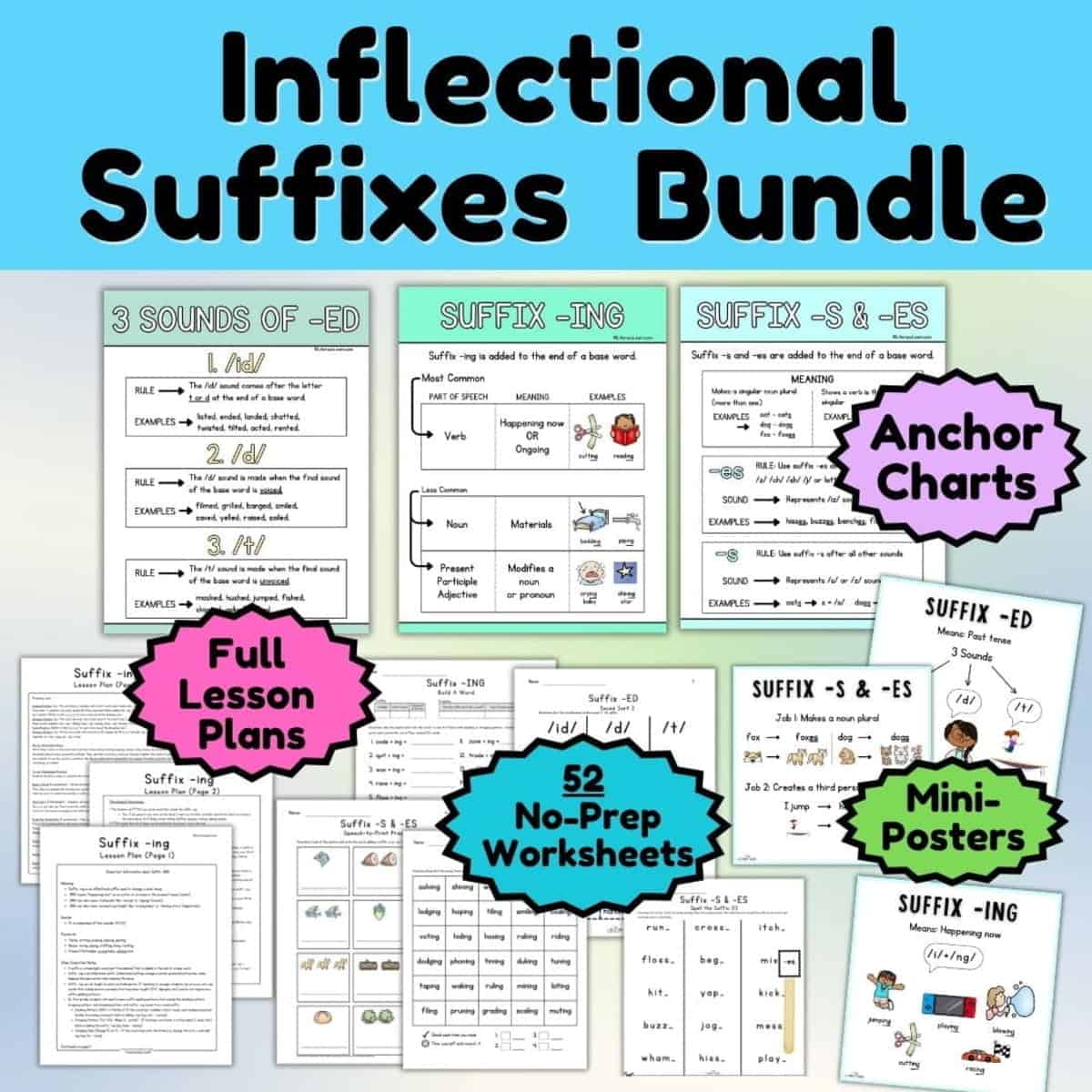
👆🏼 Grab lesson plans and all the resources you need for teaching in our Inflectional Suffixes bundle.
As students progress, instruction and practice related to other less common, but still widely used suffixes used in English words will require attention.
Derivational suffixes are more complex. They can change the meaning and/or the part of speech of a word, and a lot of words contain more than one suffix.
For example, think about the word accident. Most kids can define this word and use it in a sentence. But when we add the suffixes -al + -ly = accidentally – this longer word might become a challenge to try to define since the suffixes are changing the part of speech from a noun to an adjective (+ -al) and finally into an adverb (accident + al + ly).
Rather than asking kids to define derivational suffixes explicitly, Stahl (1999) suggests in his study that it is better for students to have a lot of meaningful experiences with words that contain those suffixes.
Through repeated exposure and guided practice, students will notice patterns, make connections, and begin applying what they know independently to read, spell, and understand words with suffixes.
Suffix List
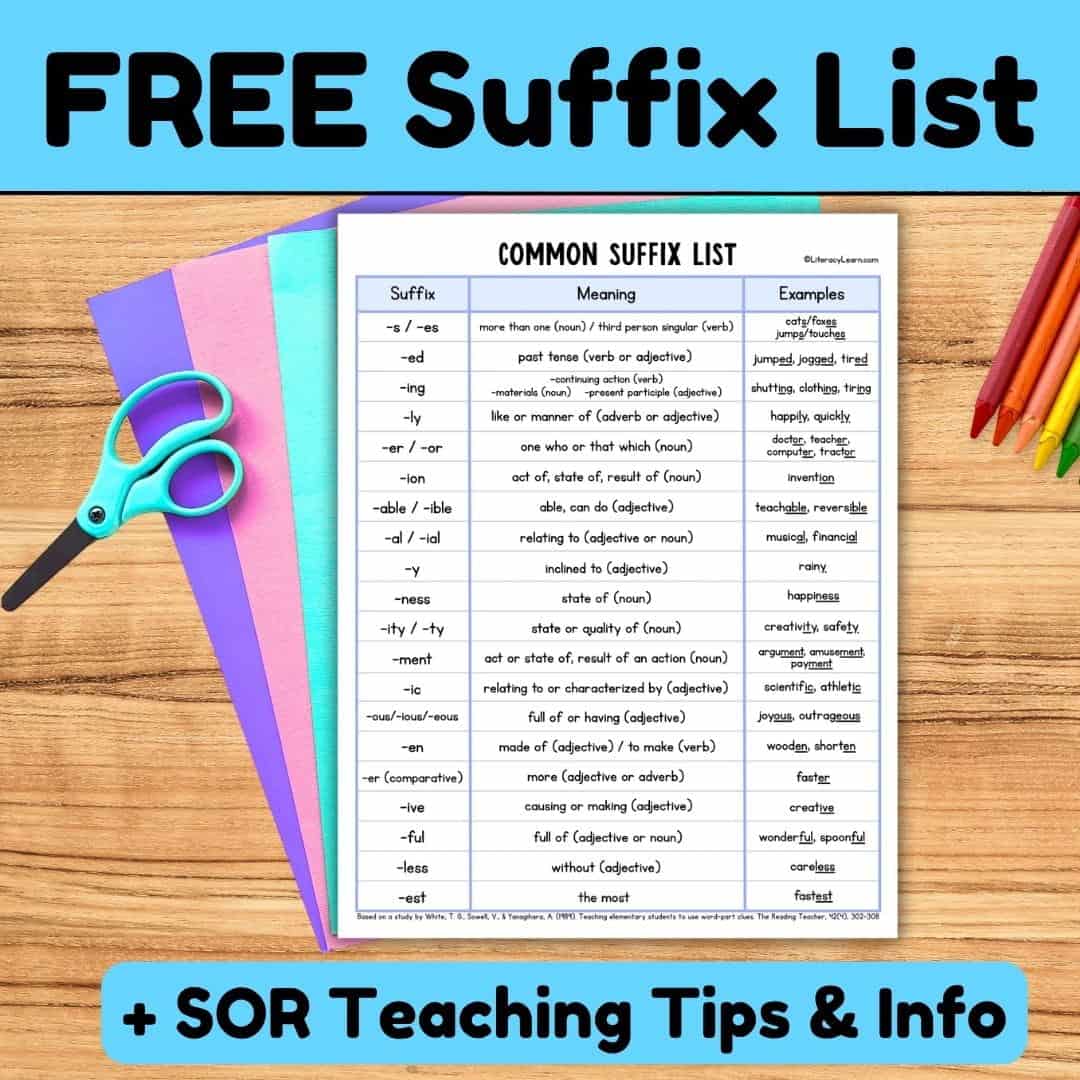
Here is a list of the 20 most common suffixes with the meanings and examples. Together, they comprise over 93% of all suffixes used in English words.
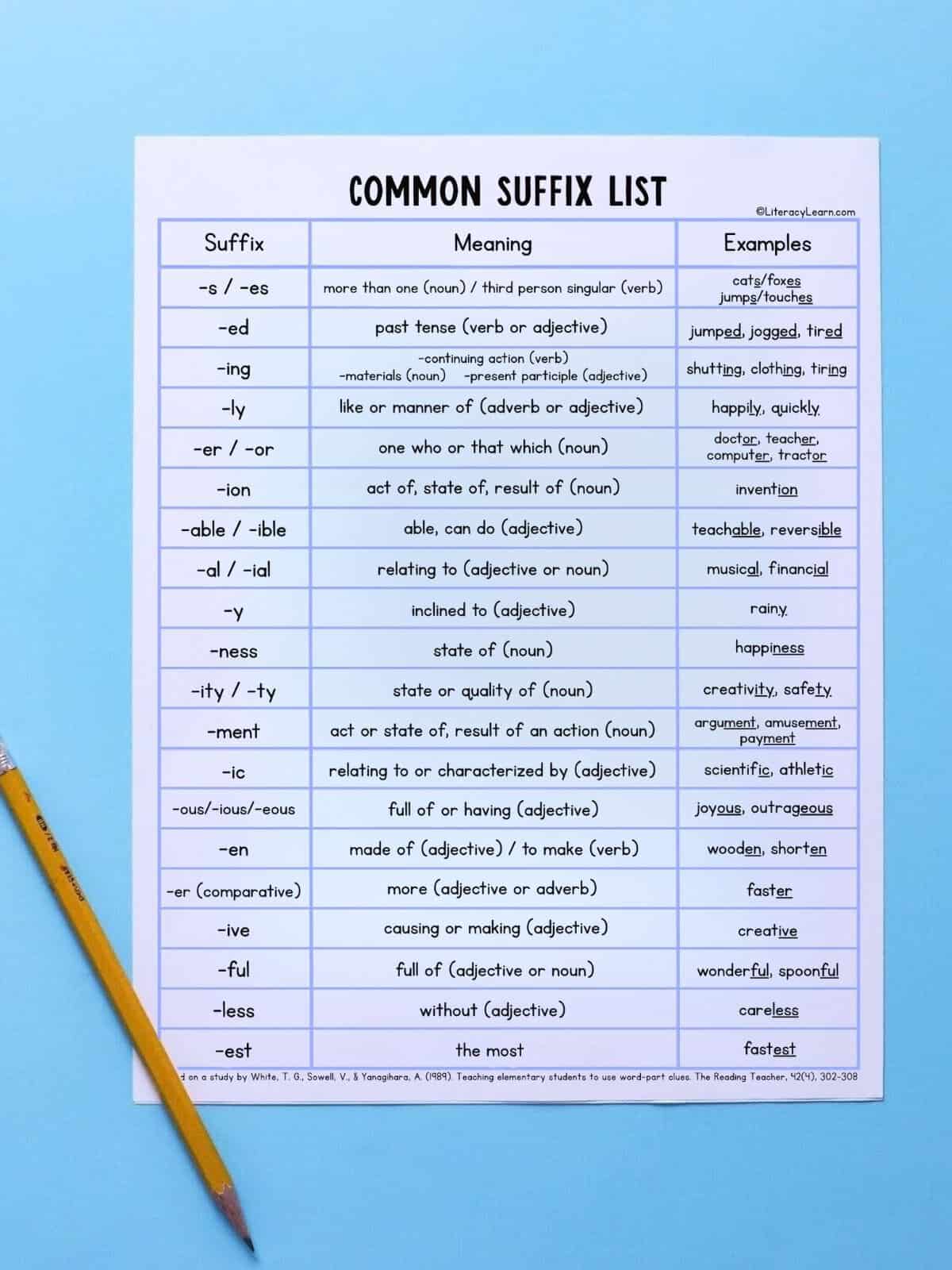
🖨️ Get the printer-friendly version at the bottom of this post for FREE!
| Suffix | Meaning | Examples |
| -s / -es | -More than one (noun) -Third person singular (verb) | cats/foxes jumps/touches |
| -ed | past tense (verb or adjective) | jumped, jogged bored, tired |
| -ing | -continuing action (verb) -materials (noun) -present participle (adjective) | shutting, moving, closing flooring, clothing tiring, exciting |
| -ly | like or manner of (adverb or adjective) | happily, quickly |
| -er / -or | one who or that which (noun) | teacher, computer doctor, tractor |
| -ion | act of, state of, result of (noun) | invention |
| -able / -ible | able, can do (adjective) | teachable reversible |
| -al / -ial | relating to (adjective or noun) | musical financial |
| -y | inclined to (adjective) | rainy |
| -ness | state of (noun) | happiness |
| -ity / -ty | state or quality of (noun) | safety creativity |
| -ment | act or state of, result of an action (noun) | argument (act of) amusement (state of) payment (result of an action) |
| -ic | relating to or characterized by (adjective) | scientific athletic |
| -ous / -ious / -eous | full of or having (adjective) | joyous anxious outrageous |
| -en | made of (adjective) to make (verb) | wooden shorten |
| -er (comparative) | more (adjective or adverb) | faster |
| -ive | causing or making (adjective) | creative |
| -ful | full of (adjective or noun) | wonderful spoonful |
| -less | without (adjective) | careless |
| -est (superlative) | the most | fastest |
*This list is based on a study by White, Yanagihara, & Sowell (1989).
We also have multiple resources that help kids learn about suffixes and get lots of experiences with suffixed words, including those that share the same morphemes.
Be sure to check out some of our favorites:
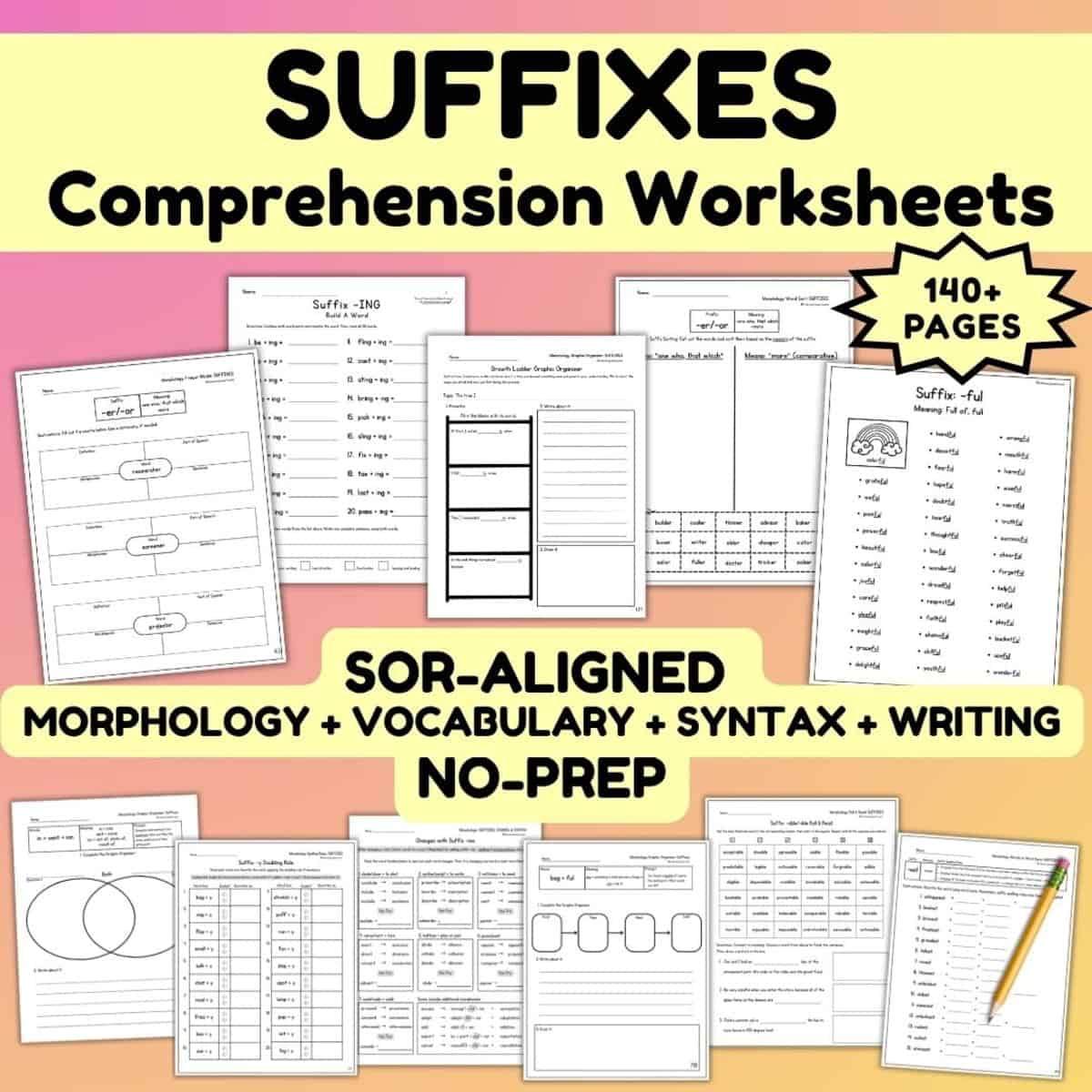
- Suffix Morphology Worksheets
- Prefix & Suffix Word Ladders
- Morphology Word Cards
- Inflectional Suffix Mega Bundle
♾️ Did you know that you can get everything listed above (plus tons more!) in our Unlimited SOR Library when you become an exclusive member? Check it out today!
References:
- Stahl, S. A., & Shiel, T. G. (1992). Teaching meaning vocabulary: Productive approaches for poor readers. Reading and Writing Quarterly: Overcoming Learning Difficulties, 8, 223–241.
- White, T. G., Sowell, V., & Yanagihara, A. (1989). Teaching elementary students to use word-part clues. The Reading Teacher, 42(4), 302–308
Download & Print

MORE Freebies: Suffix -s/-es Sound Sort, Suffix -ed Poster
♾️ Get Unlimited SOR Printables in the members-only library!
DOWNLOAD TERMS: All of our resources and printables are designed for personal use only in homes and classrooms. Each teacher must download his or her own copy. You may not: Save our files to a shared drive, reproduce our resources on the web, or make photocopies for anyone besides your own students. To share with others, please use the social share links provided or distribute the link to the blog post so others can download their own copies. Your support in this allows us to keep making free resources for everyone! Please see our Creative Credits page for information about the licensed clipart we use. If you have any questions or concerns regarding our terms, please email us. Thank you!