Halloween Charades Descriptive Writing – FREE Printables
This post may contain affiliate links. As an Amazon affiliate, we earn from qualifying purchases.
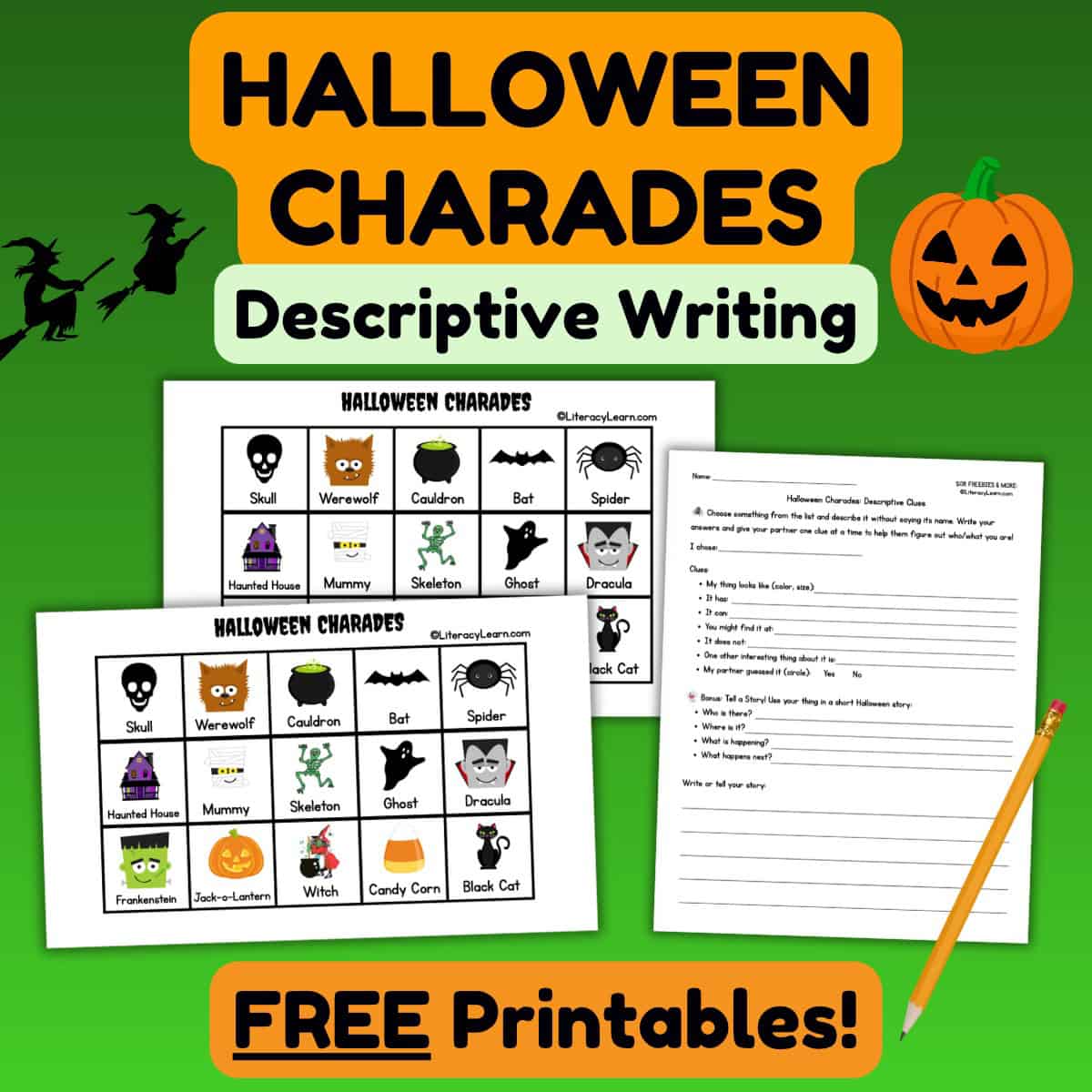
Looking for a fun way to get students talking, listening, organizing ideas, and using descriptive language? Free printable Halloween Charades is a simple partner activity that gets students practicing these skills while having fun!
Why We Love It
Students choose a Halloween character or object and give their partner clues to help them figure out what they’ve chosen, without actually saying the name.
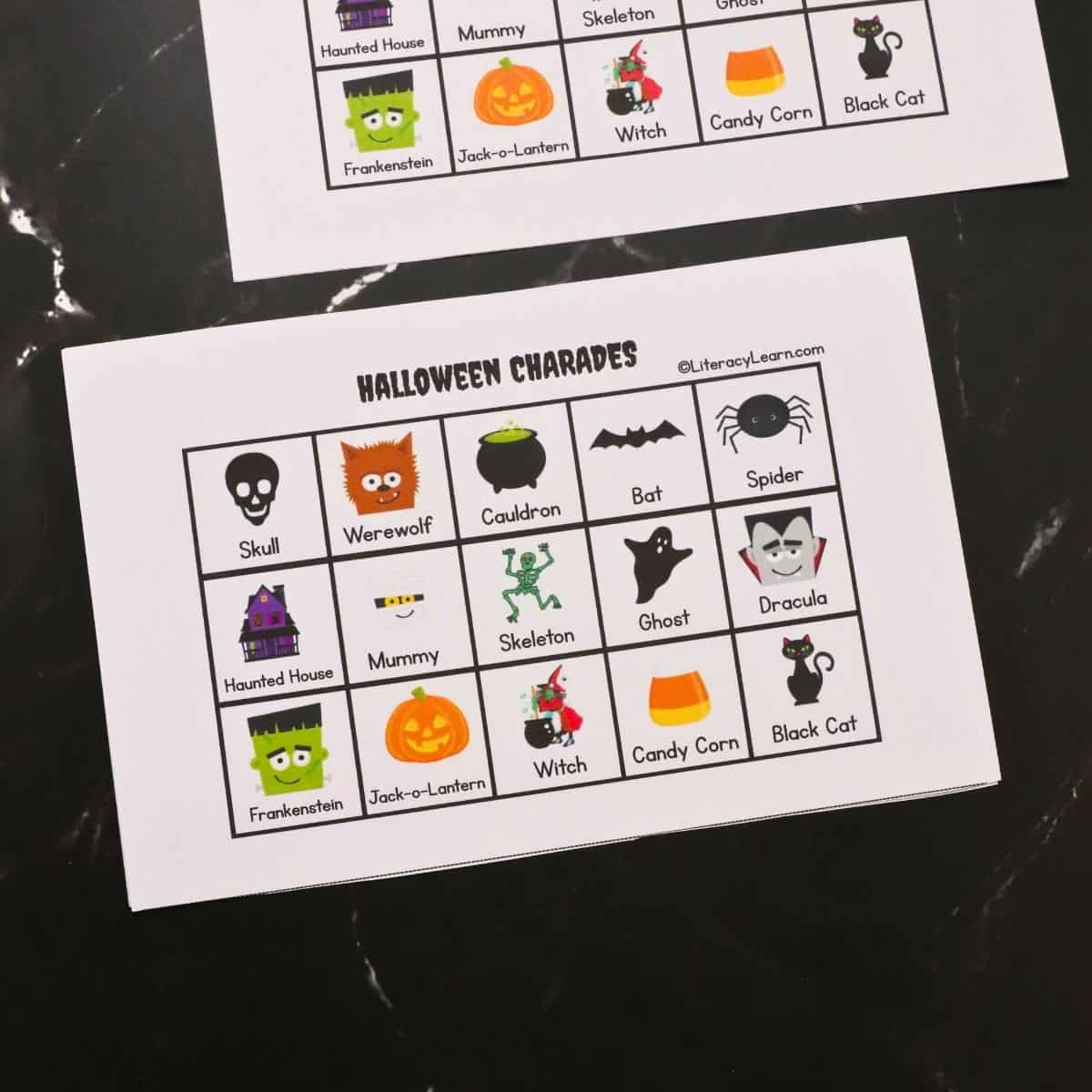
The activity includes a variety of Halloween-themed words like skull, werewolf, cauldron, bat, spider, haunted house, mummy, skeleton, ghost, Dracula, Frankenstein, witch, candy corn, and black cat.
OPTIONAL: You can cut the squares out, place them in a hat, and have students draw them to play traditional charades, OR you can use our descriptive writing and story activity (see below!).
How to Use
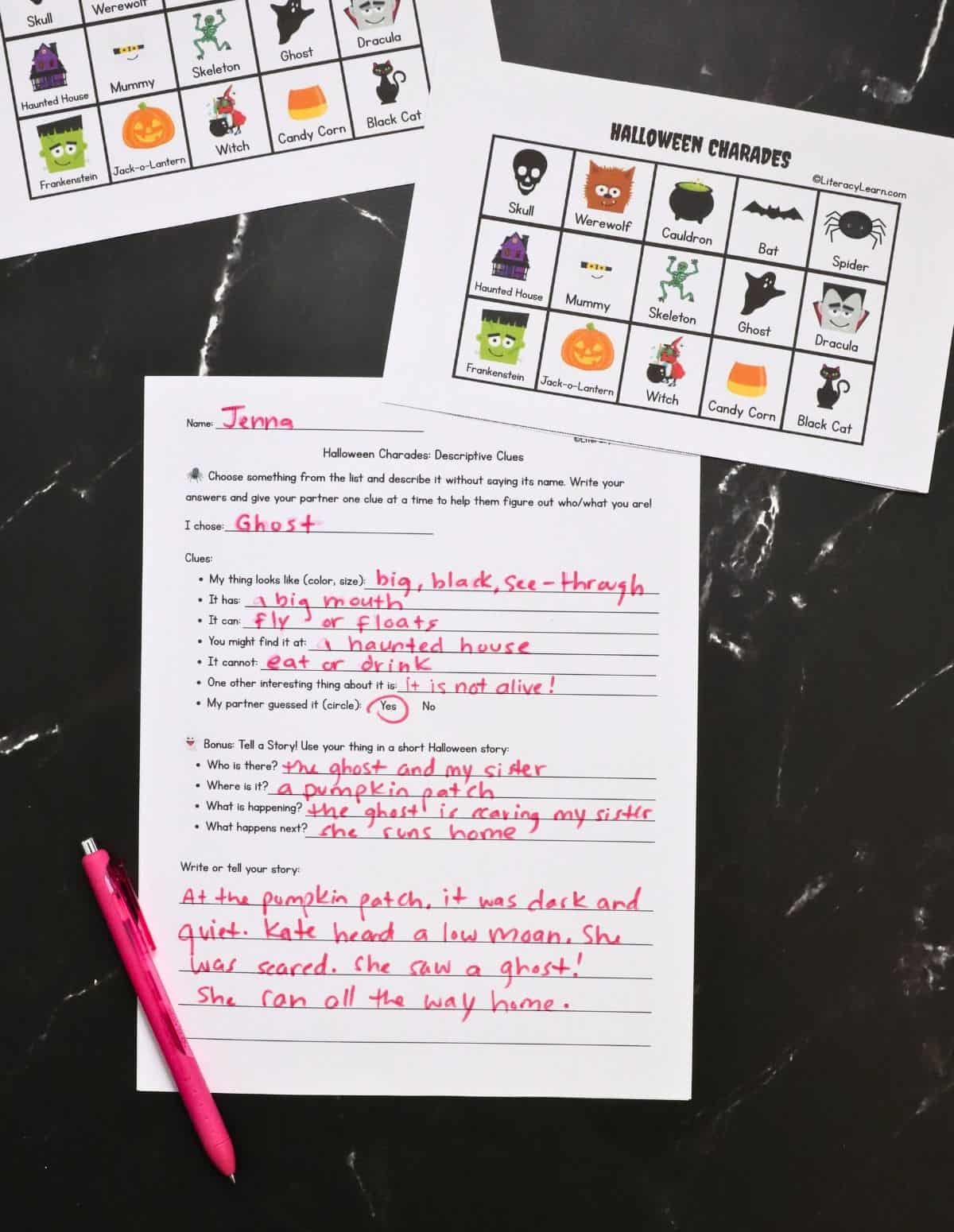
- Cut the character board page in half. Laminate for extended use. Each student gets one character board and one descriptive writing worksheet.
- Start by reviewing the Halloween vocabulary with your students. Some students may know all of the words, while others may need a little help with words like cauldron, werewolf, or Frankenstein.
- Have students secretly choose their character, write it on the page, and then work through the clue questions.
- Once they’re both done filling in the clue section, students take turns reading one clue at a time to their partner. Good descriptions help your partner guess quickly! The goal isn’t just to see who can guess the fastest, it’s to see whether students can give enough useful information for their partner to figure it out.
- Students can record whether their partner guessed correctly.
- BONUS: The outline questions are a simple framework to create a story. Students can write their story or tell it orally. This is a great way to move from describing one thing to actually using that thing in a narrative. For example, a student who chose a skeleton might create a story about a skeleton who wakes up in a haunted house and discovers that someone has taken his favorite Halloween candy!
Helpful TIPS:
I recommend modeling the activity before turning students loose with a partner. Choose one item from the list and give a few clues without saying the word.
For example:
“My thing is small. It has eight legs. It can crawl. You might find it in a dark corner. It does not have wings.”
See if students can figure out your answer!
Encourage Good Descriptive Clues
Playing this version of charades gives you an opportunity to talk about what makes a good clue.
Students will often start with clues like:
- “It’s scary.”
- “It’s a Halloween thing.”
- “It’s creepy.”
Those clues aren’t necessarily wrong, but they don’t give their partner much information!
Encourage students to think about what their character or object looks like, sounds like, has, can do, where you might find it, or what makes it unique.
Instead of: “It’s scary.”
Try: “It is black and has eight long legs.”
The more specific the description, the easier it is for the listener to create a mental picture.
Make Students Work for the Answer!
One way to make the game more challenging is to encourage students to start with less obvious clues and save their strongest clue for later.
For example, if the answer is bat, a student might say:
- “You might find it outside.”
- “It is small.”
- “It has wings.”
- “It can fly at night.”
Students have to listen carefully and put all of the clues together before making their guess. You can even make a rule that the guessing partner can’t guess until they’ve heard at least three clues!
Don’t Skip the Speaking!
I would definitely encourage them to say the clues aloud.
This makes the activity much more than simple charades. Students are practicing putting their thoughts into words, using descriptive vocabulary, speaking in complete sentences, and listening carefully to someone else.
Scaffolds/Differentiation:
For students who struggle with coming up with clues independently, the sentence starters on the page provide an easy scaffold.
If students need a little extra support, try:
- Reviewing the vocabulary before starting.
- Letting students choose from only a few items.
- Having students draw their chosen item first.
- Having kids use the sentence starters while they talk.
- Letting students give their clues orally without writing them first.
In a small group:
- Have one student give the clues while everyone else listens and guesses at the end.
For students who are ready for more of a challenge:
- Ask them to use specific adjectives and descriptive phrases or give them a minimum number of clues before their partner can guess.
- You can also ask students afterward, “Which clue helped your partner the most?” That’s a simple way to get them thinking about how word choice affects communication.
More Halloween Resources
Download & Print

DOWNLOAD TERMS: All of our resources and printables are designed for personal use only in homes and classrooms. Each teacher must download his or her own copy. You may not: Save our files to a shared drive, reproduce our resources on the web, or make photocopies for anyone besides your own students. To share with others, please use the social share links provided or distribute the link to the blog post so others can download their own copies. Your support in this allows us to keep making free resources for everyone! Please see our Creative Credits page for information about the licensed clipart we use. If you have any questions or concerns regarding our terms, please email us. Thank you!
More Freebies: Halloween Morphology Printables.
♾️ Get Unlimited SOR Printables in the members-only library!