
Shades of Meaning: Word Nuance for Vocabulary & FREE Chart
This post may contain affiliate links. As an Amazon affiliate, we earn from qualifying purchases.
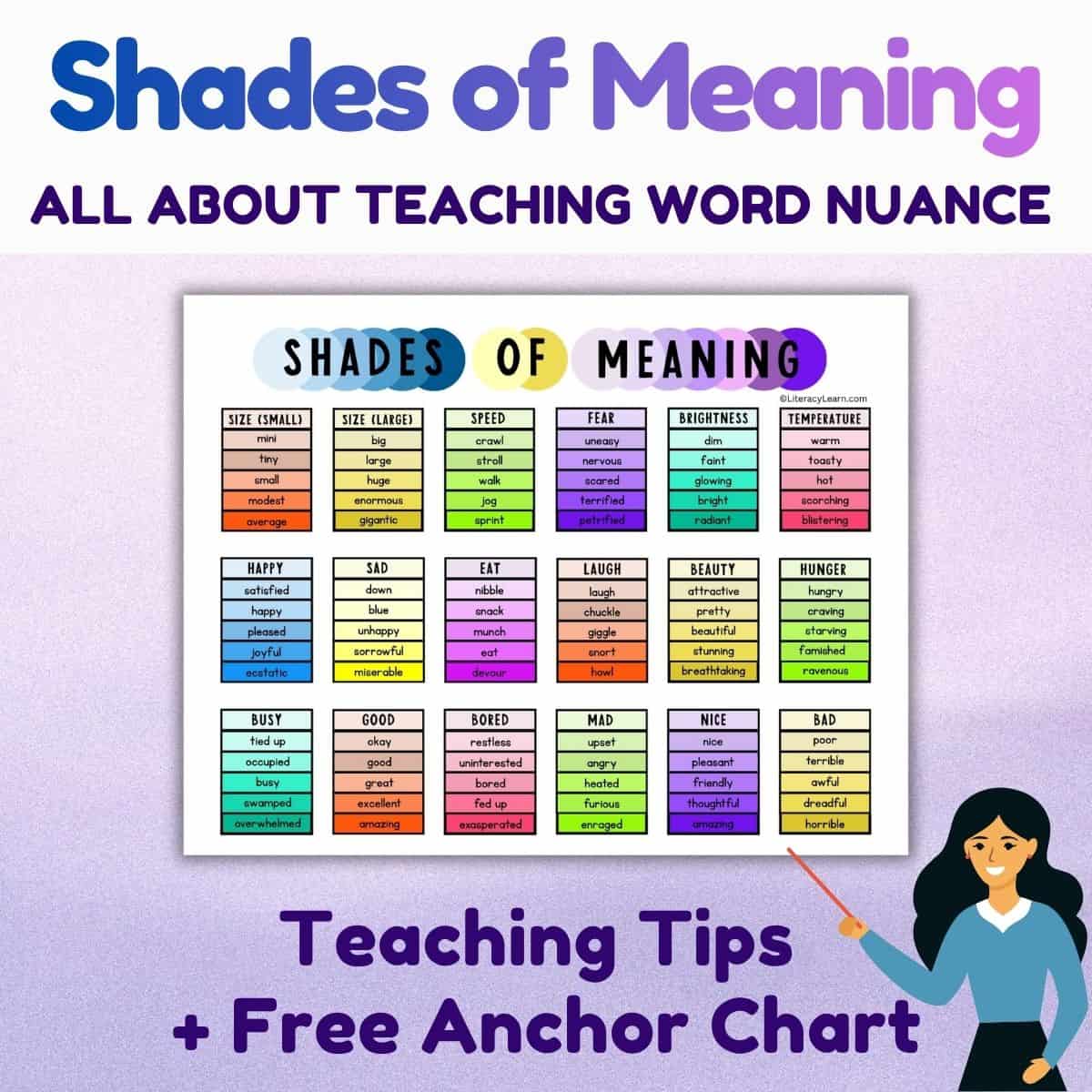
Learn all about Shades of Meaning: what it is, why it matters, and how to teach it. As a bonus, get a free printable anchor chart to help kids understand and practice word choice, build their oral and written vocabulary, and truly understand shades of meaning.
What Is Shades of Meaning?
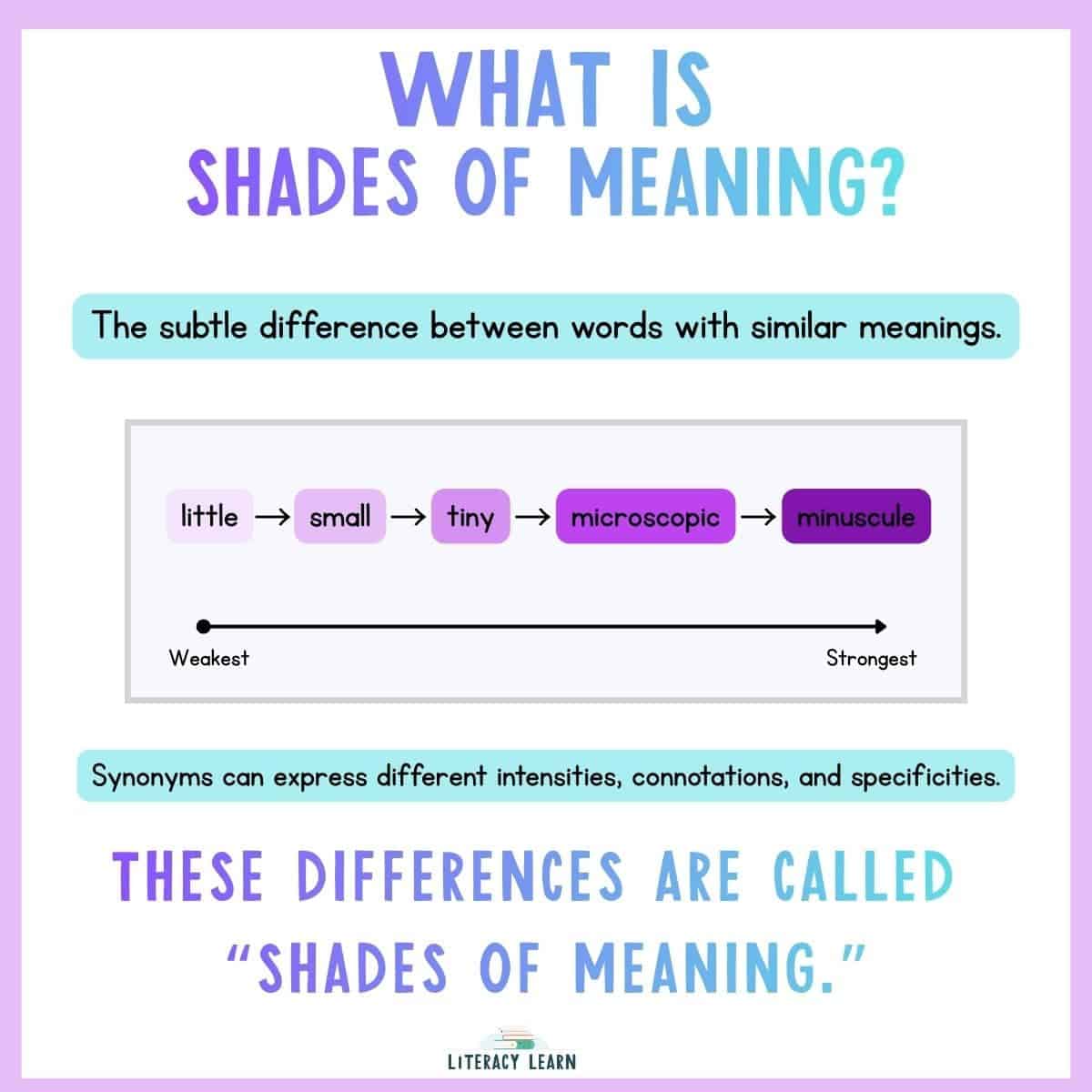
Shades of meaning refers to the subtle differences between words that have similar meanings. Even though synonyms can mean almost the same thing, each word can show a different level of intensity or feeling.
For example: little → small → tiny → microscopic → miniscule
You can see how each word expresses a slightly different degree of intensity. These differences are what we call “shades of meaning.”
Why Teach Shades of Meaning?
Teaching shades of meaning offers several benefits related to vocabulary and comprehension. These are two of the pillars of literacy identified by the National Reading Panel (2000).
1. Semantics, or meaning, is a key component of the language comprehension strand of Scarborough’s Reading Rope. When using a structured literacy approach, teaching shades of meaning builds strong vocabulary and supports deeper overall comprehension.
2. Both oral vocabulary and written vocabulary are expanded. Kids are encouraged to avoid overused words and choose clearer, more precise words when they speak and write.
3. Comprehension is deepened. Authors carefully pick words to show tone, emotion, and purpose. When kids understand shades of meaning, they can better understand what the author is trying to communicate as they read.
3. Teaching shades of meaning builds an interest in words, and kids generally like the activities used to practice them!
“If we can get students interested in playing with words and languages, then we are at least halfway to the goal of creating the sort of word-conscious students who will make words a lifetime interest.” – M. Graves (2000)
Overall, teaching shades of meaning helps students move beyond simply memorizing groups of synonyms. It encourages kids to think about word choice and builds a deeper awareness of how meaning (semantics) works in language.
Different Types of Shades of Meaning
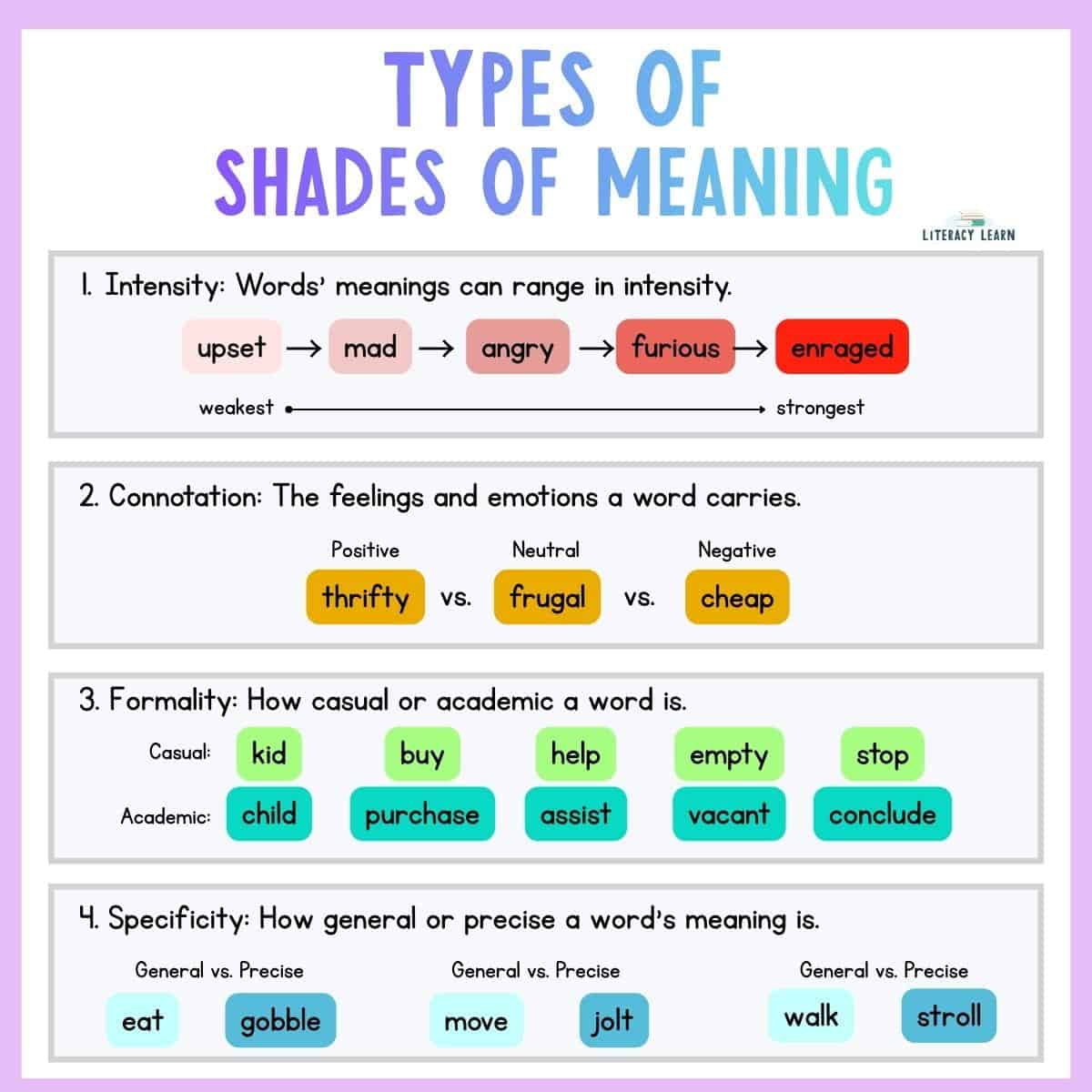
There are four main categories that can describe word nuances: intensity, connotation, formality, and specificity. We’re breaking down those categories below:
Intensity
For example:
- happy → joyful → ecstatic
- tired → weary → exhausted
- good → excellent → outstanding
When we think about word intensity, we look at how strong or weak a word’s meaning is. One way to teach this is by arranging synonyms from the least intense to the most intense.
These word chains show kids that even though the words have similar meanings, they don’t all carry the same strength. Some are mild, while others are more powerful.
Just remember, the goal isn’t to pick the strongest word. We want students to use words that best matches the situation and meaning they’re trying to convey.
Connotation (Positive/Neutral/Negative Feelings)
Connotation refers to the feelings or emotions a word brings with it. Even if two words have similar meanings, they can create different impressions. A word can have a positive, negative, or neutral connotation.
Think about these examples:
- chatty vs. blabbermouth
- slender vs. skinny
- thrifty vs. cheap
If I described my cousin as chatty, you’d picture someone who enjoys talking. But If I call her a blabbermouth, you’d imagine someone who talks too much or gossips. The meaning of the words is similar, but the feeling is very different.
Teaching students about connotation is important; they learn how word choice can shape the mood, tone, and message that’s being communicated.
Formality (Academic vs. Everyday Language)
Formality is about how formal (academic) or informal (casual) a word is. We often use casual words in our speaking. But when we’re writing, using academic language may be more appropriate.
Knowing the differences helps kids think bout word choice for the situations they’re in for both speaking and writing.
Here are some casual vs academic word examples:
- kid vs. child
- buy vs purchase
- help vs assist
- get vs. obtain
- show vs. demonstrate
Specificity (General vs. Precise)
Specificity refers to how general or precise a word’s meaning is. Some words give us a general picture like “move” while others give a more precise picture like “jolt.” As words become more specific, they add detail, intensity, and nuance.
Some other examples of general vs. precise include:
- look → stare
- say → persuade
- eat → gobble
Activities for Teaching Shades of Meaning
Below are some specific ideas for teaching shades of meaning to students.
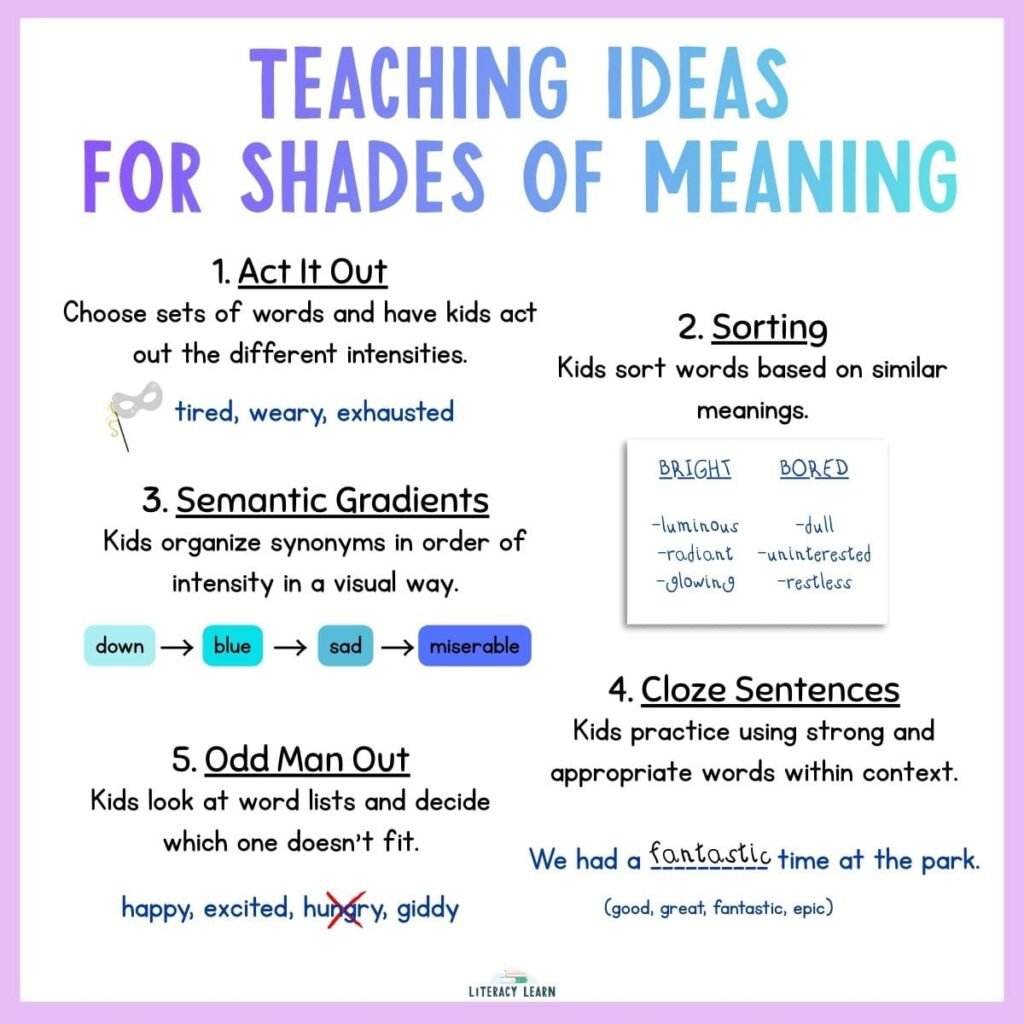
🎭 Act it Out
Kids can act out various levels of intensity: tired → weary → exhausted. Kids will see as the words become more intense, their acting should become more dramatic.
📏 Semantic Gradients
Semantic gradients are also known as word continuums. This activity includes placing words with similar meanings on a continuum, shifting from one meaning to another. Usually, words are organized from least to most intense.
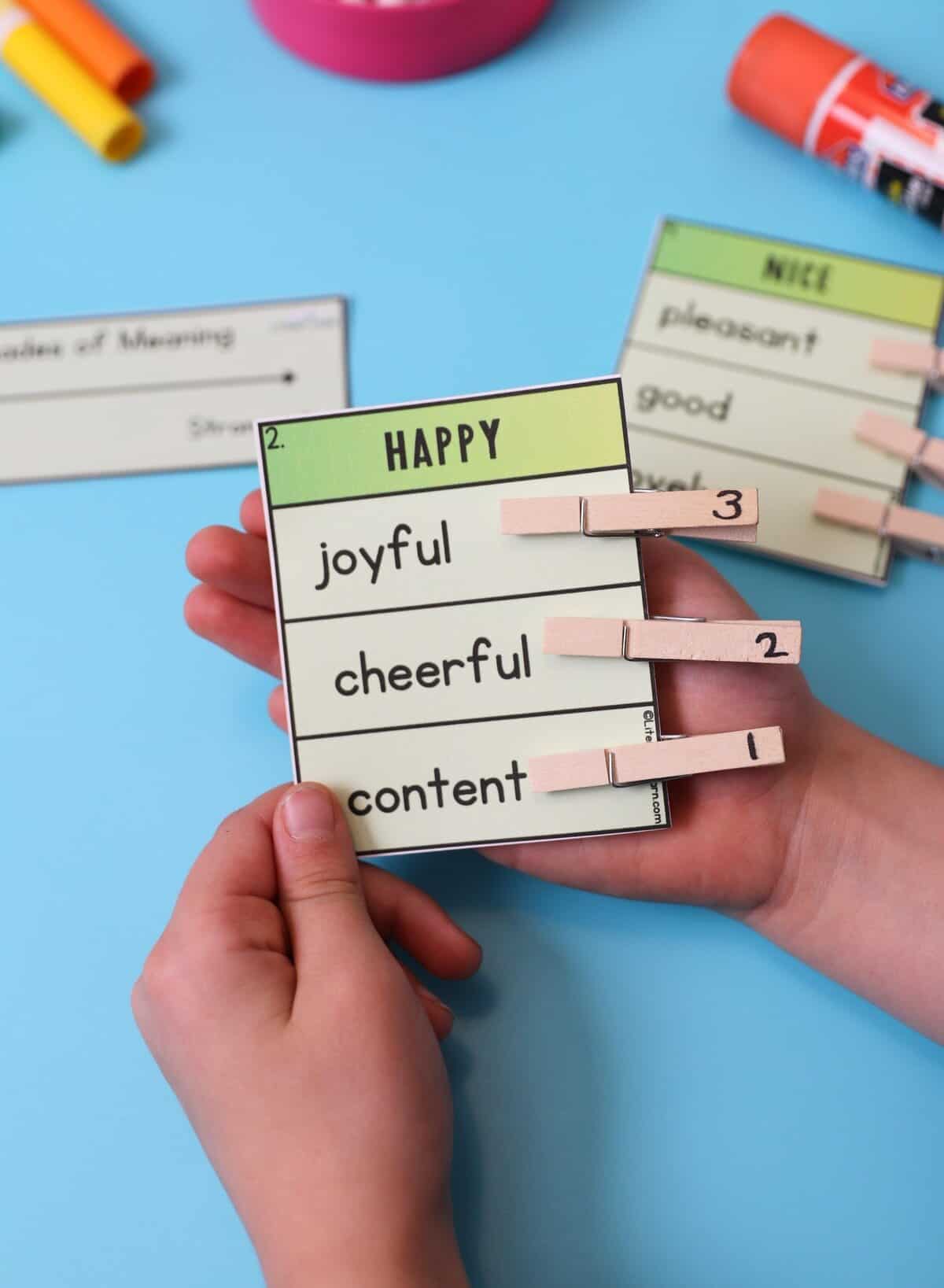
⭐️ Get our Word Continuums on TPT or LL Unlimited!
Paint chips are often used because they provide a powerful visual image of the “shades” changing slightly but still related.
For further reading, Reading Rockets has a helpful article about semantic gradients.
👎🏽 Odd Man Out
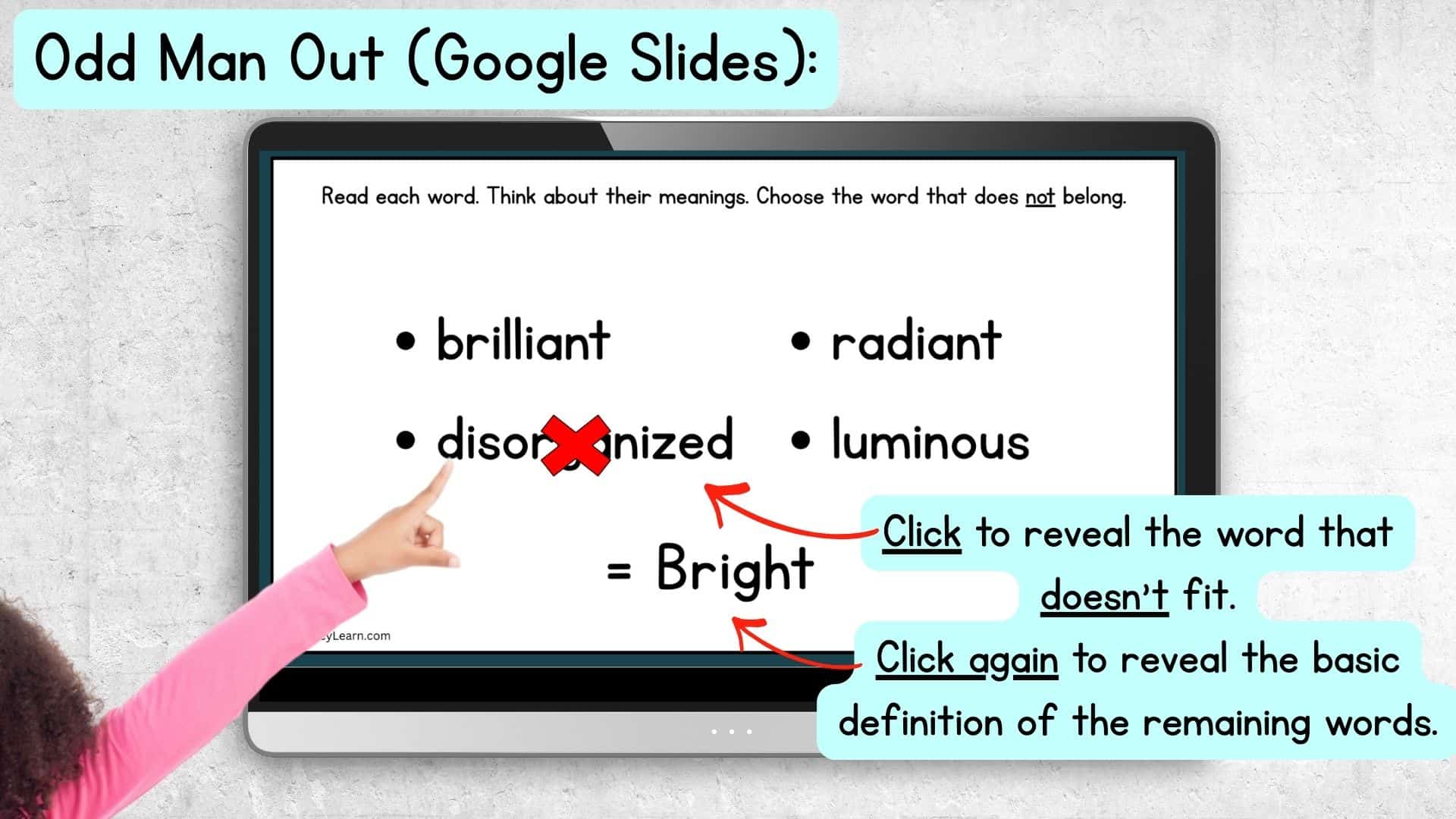
This activity provides kids with a set of words that are synonyms, except for one that definitiely doesn’t belong.
For example: happy, excited, giddy, hungry.
The first three words clearly relate in meaning, while “hungry” stands apart with a completely different idea.
Activities like this help students easily notice which words share similar meanings to identify the “odd man out.” It’s a very simplistic way to understand semantic connections between words.
⭐️ Grab our no-prep Google Slides activity + so much more!
📝 Cloze Sentences
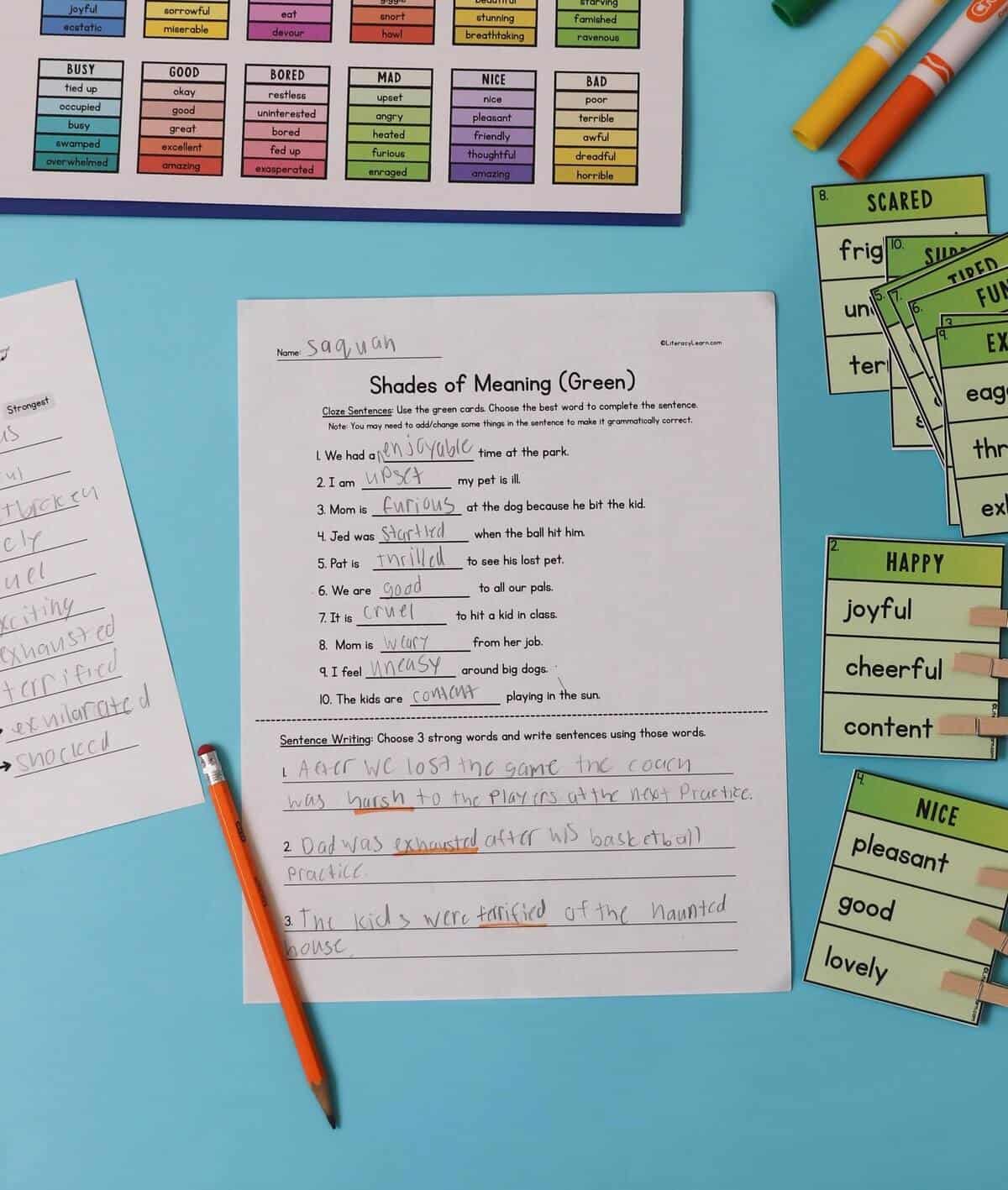
Providing students with pre-written cloze sentences (sentences with a blank space for the chosen vocabulary word) can be a powerful and fun activity.
“The cookies mom made were __________ , so I ate two.” (good, tasty, delicious, scrumptious)
🃏 Sort Cards
We use sorting activities for phonics skills all the time – so why not apply the same idea to vocabulary activities?
Give students groups of words and have them sort by meaning.
You can start by using closed sorts, where the teacher provides the broader category and students sort the related words beneath it. Then you can move to using open sorts where kids determine the main categories that words belong to.
Both are great options for boosting kids’ vocabulary awareness and understanding.
Free Shades of Meaning Anchor Chart
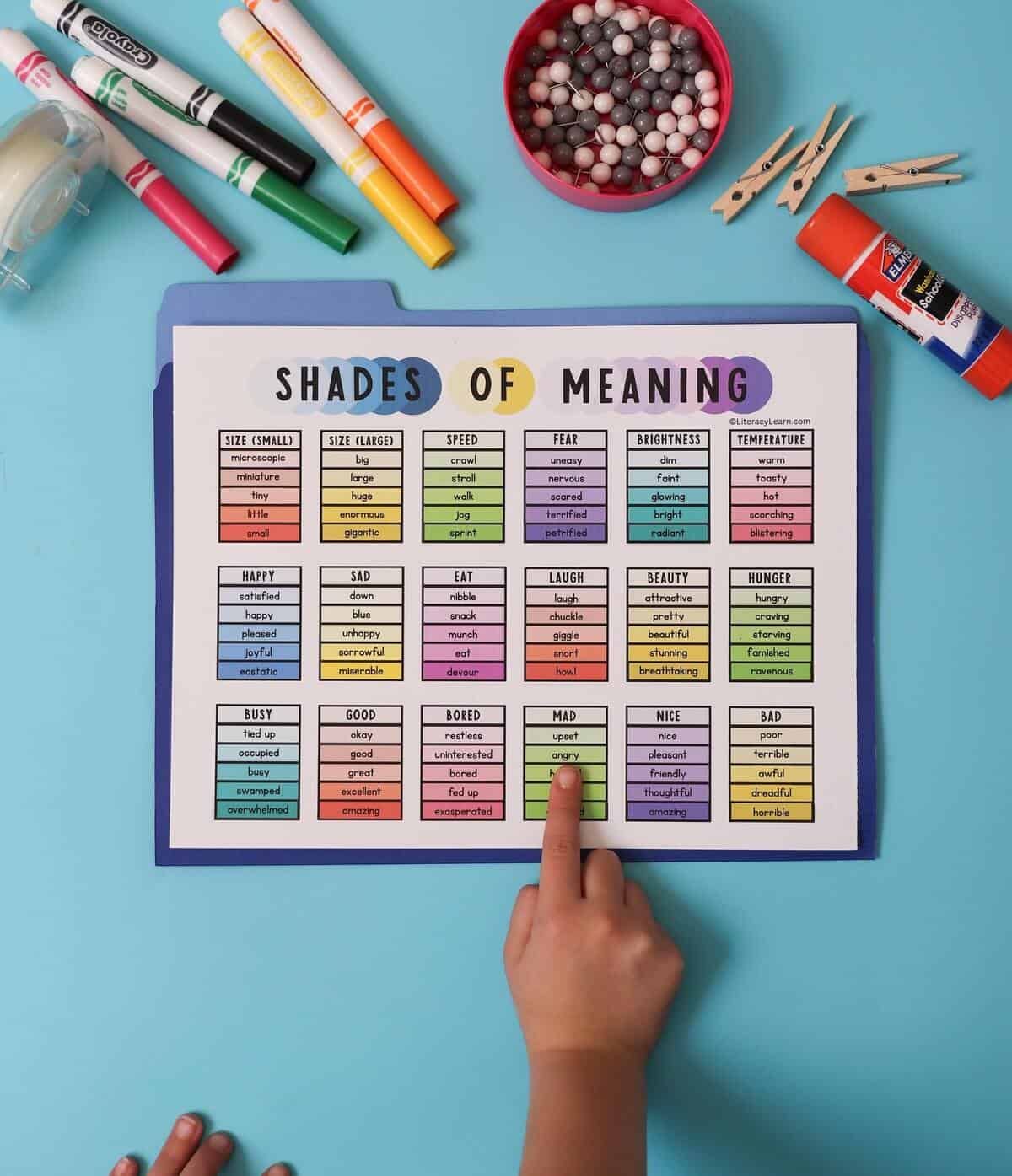
We’re giving away a free anchor chart to help kids see common terms and their shades of meaning.
Perfect for…
- Mini-Lessons
- Writing Workshops
- Vocabulary Journals or Writing Notebooks
- Shades of Meaning Centers
- Intervention Groups
- Using with ELL students
🤩 Looking for more great ways to teach vocabulary?
Check out our recommendation for the best vocabulary-building books, and then grab our free and customizable word matrix, homophone book, and alphaboxes graphic organizer.
🖨️ Download & Print
DOWNLOAD TERMS: All of our resources and printables are designed for personal use only in homes and classrooms. Each teacher must download his or her own copy. You may not: Save our files to a shared drive, reproduce our resources on the web, or make photocopies for anyone besides your own students. To share with others, please use the social share links provided or distribute the link to the blog post so others can download their own copies. Your support in this allows us to keep making free resources for everyone! Please see our Creative Credits page for information about the licensed clipart we use. If you have any questions or concerns regarding our terms, please email us. Thank you!

MORE Freebies: Semantic Mapping, Idioms Worksheet, Context Clues.
♾️ Get Unlimited SOR Printables in the members-only library!
This is a fantastic website for all things……READING and VOCABULARY !!!!!
I love the materials. The level of the lesson and student engagement is great during instruction.
PLEASE……PLEASE keep up the awesome articles and lessons that you share on LiteracyLearn.
Hi Agnes,
We’re so glad to hear you like the information and resources we share 🙂 Yes – we plan to keep them coming!
Katie and Laura