
20 Most Common Prefixes: Free Printable List
This post may contain affiliate links. As an Amazon affiliate, we earn from qualifying purchases.
Mastering high-frequency prefixes will give students a strong foundation for understanding and spelling words, so read about the 20 most common prefixes and then get a free printable list of the most common prefixes with meanings and examples!
What Is a Prefix?
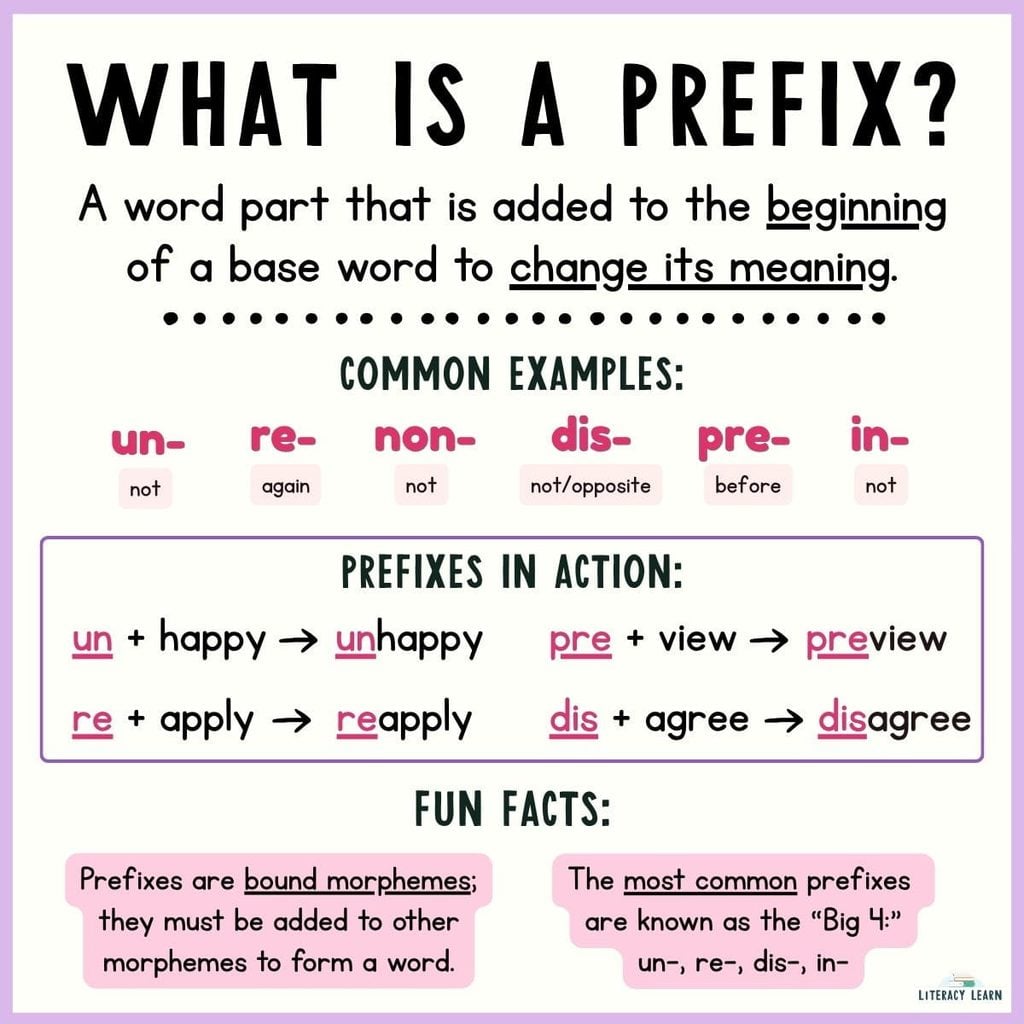
A prefix is a word part (morpheme) that attaches to the beginning of a word and carries meaning. Prefixes are bound morphemes, so they cannot stand on their own. Instead, they must attach to another morpheme.
Some examples of words with prefixes include:
- re + ply = reply
- in + fer = infer
- pre + view = preview
- over + whelm = overwhelm
- mis + trans + late = mistranslate
Benefits of Teaching Prefixes
M.F. Graves (2004) gives a few reasons why prefixes should be taught.
- There aren’t that many prefixes to learn. English has a relatively small number of common prefixes, so teaching them does not take a lot of time and does not create a cognitive overload for students.
- Prefixes are frequent and appear in many English words. Learning a small number of common prefixes can help students understand and decode a large number of words.
- Prefixes have consistent spellings. Unlike some spelling patterns in English, prefixes tend to maintain consistent spellings in words.
- Prefixes are easy to spot. Because prefixes occur at the beginning of words, students can easily identify them as they read and spell.
- Most prefixes have clear, straightforward meanings. Once students understand what a prefix means, they can use it as a word part clue to help determine the meaning of an unfamiliar word.
Common Prefixes
This study found that “a handful of prefixes account for a large percentage of prefixed words” (1989, p. 302).
Often referred to as the “Big Four,” the prefixes un-, re-, in-, and dis- account for more than 58% of all prefixes found in words. The same researchers found that 20 prefixes account for approximately 97% of prefixed words in school reading materials.
Because these prefixes occur so frequently, they are an important starting point for explicit prefix instruction. Graves (2004) recommends that students receive explicit instruction and plenty of practice with high-frequency prefixes.
As students progress, instruction should expand to include other less common, but still widely used, prefixes.
Through explicit instruction, repeated exposure, and meaningful practice, students will begin to recognize common prefixes, notice patterns, make connections between words, and apply what they have learned independently.
Over time, knowledge of prefixes can support students’ word recognition, spelling, vocabulary, and understanding of unfamiliar words.

Teaching Tips
👉🏻 Teach students what the word parts mean. Research by Biemiller (2005) found that the meanings of unfamiliar words can be derived if kids know the meaning of the base words and affixes.
So just like we teach kids the letter A says /ă/, we also need to teach kids the prefix un- means “not or opposite.”
👉🏻 Teach students to take words apart and put them back together. For instruction to be effective, students need to learn how to break words apart into morphemes and reassemble the word parts to determine meaning.
Using word sums is great for this!
👉🏻 Be sure your instruction is systematic and cumulative. Just as a phonics scope and sequence moves from simple, high-frequency concepts to more complex, less frequent ones, your prefix instruction should follow a similar progression.
Graves (2004) suggests instruction should begin with common prefixes attached to free morphemes. Free morphemes are words that can stand on their own (e.g. happy, apply, agree, appropriate, and fat)
Let’s look at how we can add prefixes to free morphemes for very simple morphemic analysis:
- un + happy = unhappy
- re + apply = reapply
- dis + agree = disagree
- in + appropriate = inappropriate
- non + fat = nonfat
Then, as kids progress in their knowledge and understanding of morphology, they can begin analyzing more complex words, including those that don’t break apart so easily. Here are some examples:
- re + con + struct + ion = reconstruction
- in + cor + rupt + ible = incorruptible
- un + im + ped
e+ ed = unimpeded - dis + re + spect = disrespect
This is great to pair with your instruction of Greek and Latin bases (since 60% of the English language comes from Greek or Latin)!
👉🏻 Research by Baumann (2007) and Nagy & Anderson (1984) suggest one approach is grouping affixes into meaningful “families.” This means grouping prefixes by shared meanings or other common features to help students learn them more effectively.
For example, a teacher may choose to teach the prefixes that share a common meaning. Instead of teaching one prefix at a time, the teacher would teach them as a group or “family.”
In real life, this would look like teaching dis-, un-, in-, im-, il-, ir-, and non- together, since they all share the same meaning: “not or opposite of.” For more examples of affix “families,” see Table 3 in this article.
Morphology instruction is an essential component of Structured Literacy. Using these teaching tips will help you effectively teach prefixes to students in a research-supported way.
Common Prefix List
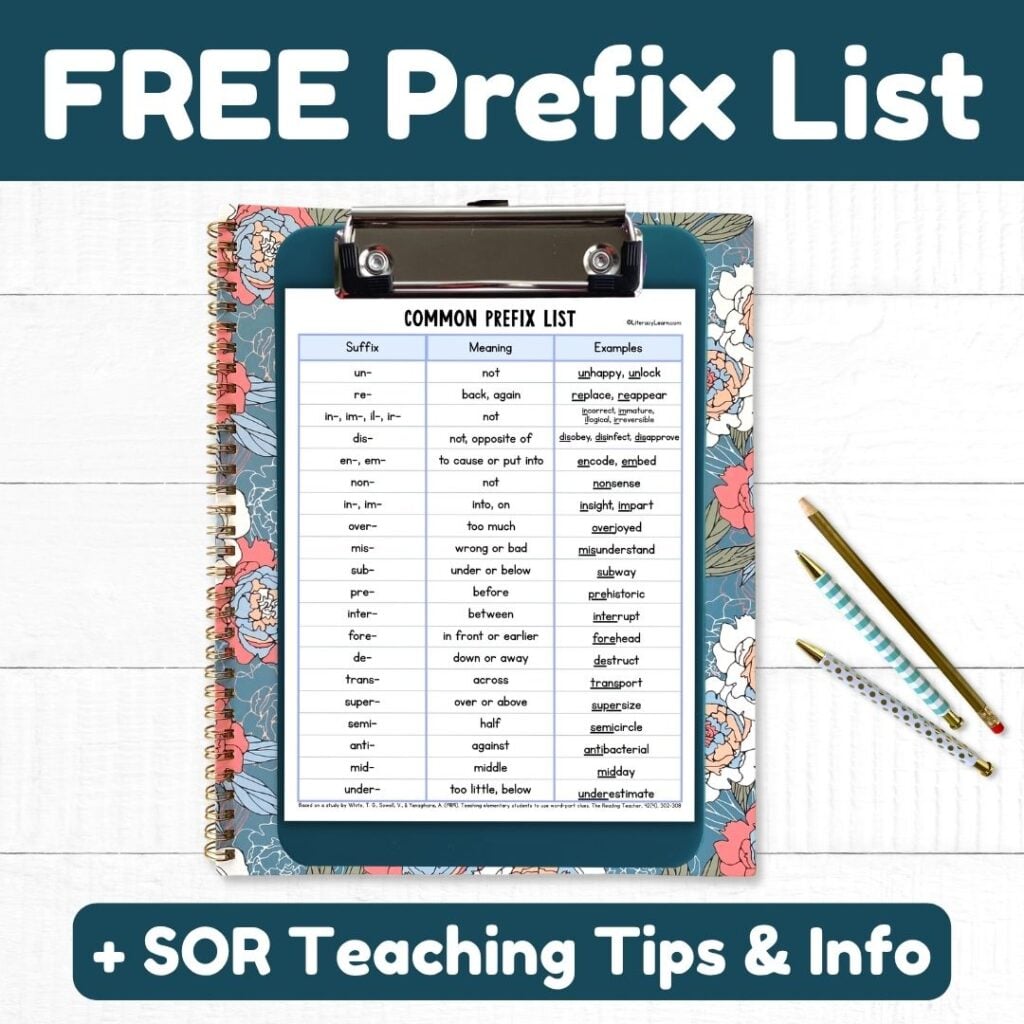
Here is a list of the 20 most common prefixes with the meanings and examples.
🖨️ Get the printer-friendly version at the bottom of this post for FREE!
| Prefix | Meaning | Examples |
| un- | not | unhappy, unlock |
| re- | back, again | replace, reappear |
| in-, im-, il-, ir- | not | incorrect, immature, illogical, irreversible |
| dis- | not, opposite of | disobey, disinfect, disapprove |
| en-, em- | to cause or put into | encode, embed |
| non- | not | nonsense |
| in-, im- | into, on | insight, impart |
| over- | too much | overjoyed |
| mis- | wrong or bad | misunderstand |
| sub- | under or below | subway |
| pre- | before | prehistoric |
| inter- | between | interrupt |
| fore- | in front or earlier | forehead |
| de- | down or away | destruct |
| trans- | across | transport |
| super- | over or above | supersize |
| semi- | half | semicircle |
| anti- | against | antibacterial |
| mid- | middle | midday |
| under- | too little, below | underestimate |
*This list is based on a study by White, Sowell, & Yanagihara (1989).
Don’t leave without grabbing the free common suffix list, too!
Related Morphology Resources
We have multiple resources that help kids learn and practice morphology. Be sure to check out some of our favorites:
- Prefix Morphology Worksheets
- Prefix & Suffix Word Ladders
- Morphology Word Cards
- Morpheme Wall
- Printable Suffix List
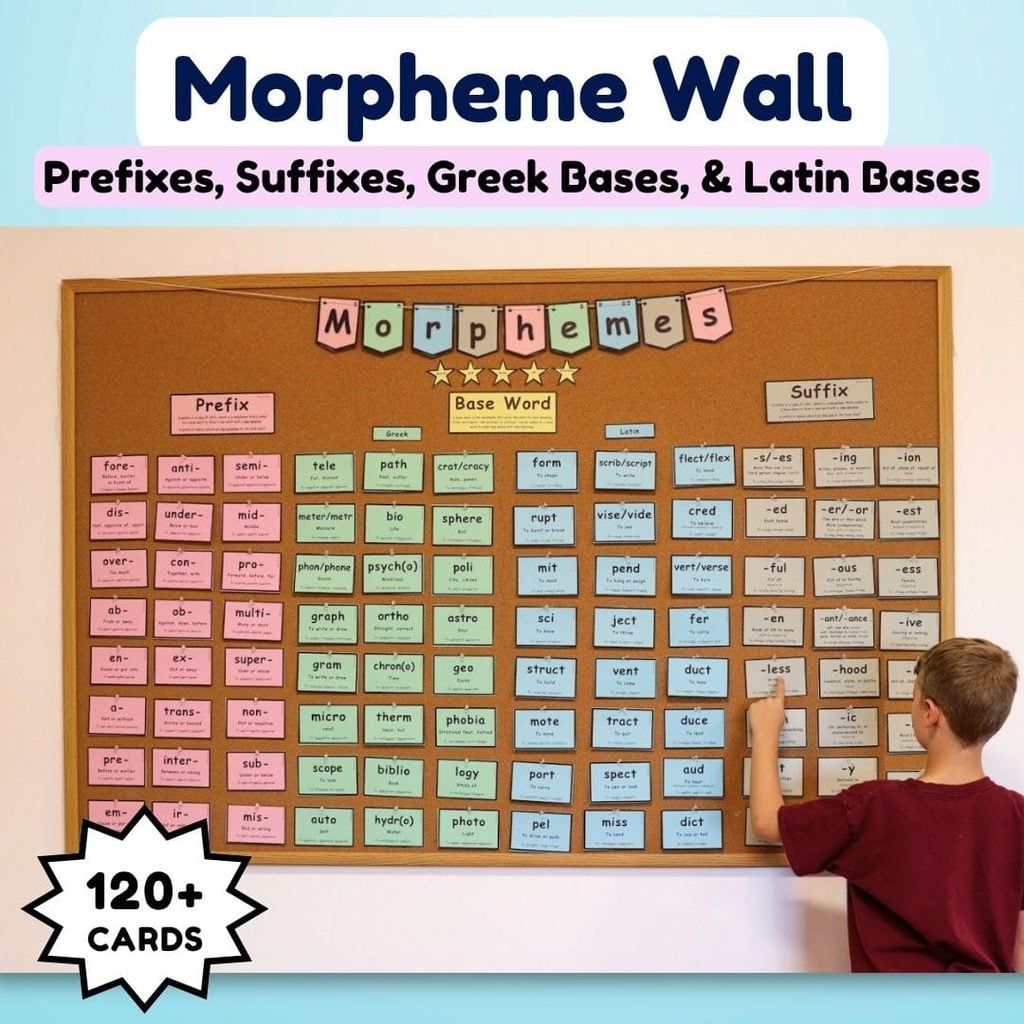
♾️ Did you know that you can get everything listed above (plus tons more!) in our Unlimited SOR Library when you become an exclusive member? Check it out today!
References:
- Baumann, J.F., Ware, D. and Edwards, E.C. (2007), “Bumping Into Spicy, Tasty Words That Catch Your Tongue”: A Formative Experiment on Vocabulary Instruction. The Reading Teacher, 61: 108-122. https://doi.org/10.1598/RT.61.2.1
- Biemiller, A. (2005). Size and Sequence in Vocabulary Development: Implications for Choosing Words for Primary Grade Vocabulary Instruction. In E. H. Hiebert & M. L. Kamil (Eds.), Teaching and learning vocabulary: Bringing research to practice (pp. 223–242). Lawrence Erlbaum Associates Publishers.
- Graves, M. F. (2004). Teaching Prefixes: As Good as It Gets?” In J.F. Baumann and E.J. Kame’enui (eds), Vocabulary instruction: Research to practice. New York: Guilford.
- White, T. G., Sowell, V., & Yanagihara, A. (1989). Teaching elementary students to use word-part clues. The Reading Teacher, 42(4), 302–308.
Download & Print

MORE Freebies: Morphology Word Chaining, Morpheme Exploration Worksheets
♾️ Get Unlimited SOR Printables in the members-only library!
DOWNLOAD TERMS: All of our resources and printables are designed for personal use only in homes and classrooms. Each teacher must download his or her own copy. You may not: Save our files to a shared drive, reproduce our resources on the web, or make photocopies for anyone besides your own students. To share with others, please use the social share links provided or distribute the link to the blog post so others can download their own copies. Your support in this allows us to keep making free resources for everyone! Please see our Creative Credits page for information about the licensed clipart we use. If you have any questions or concerns regarding our terms, please email us. Thank you!