
Orton-Gillingham Scope & Sequence: Download the FREE Guide
This post may contain affiliate links. As an Amazon affiliate, we earn from qualifying purchases.

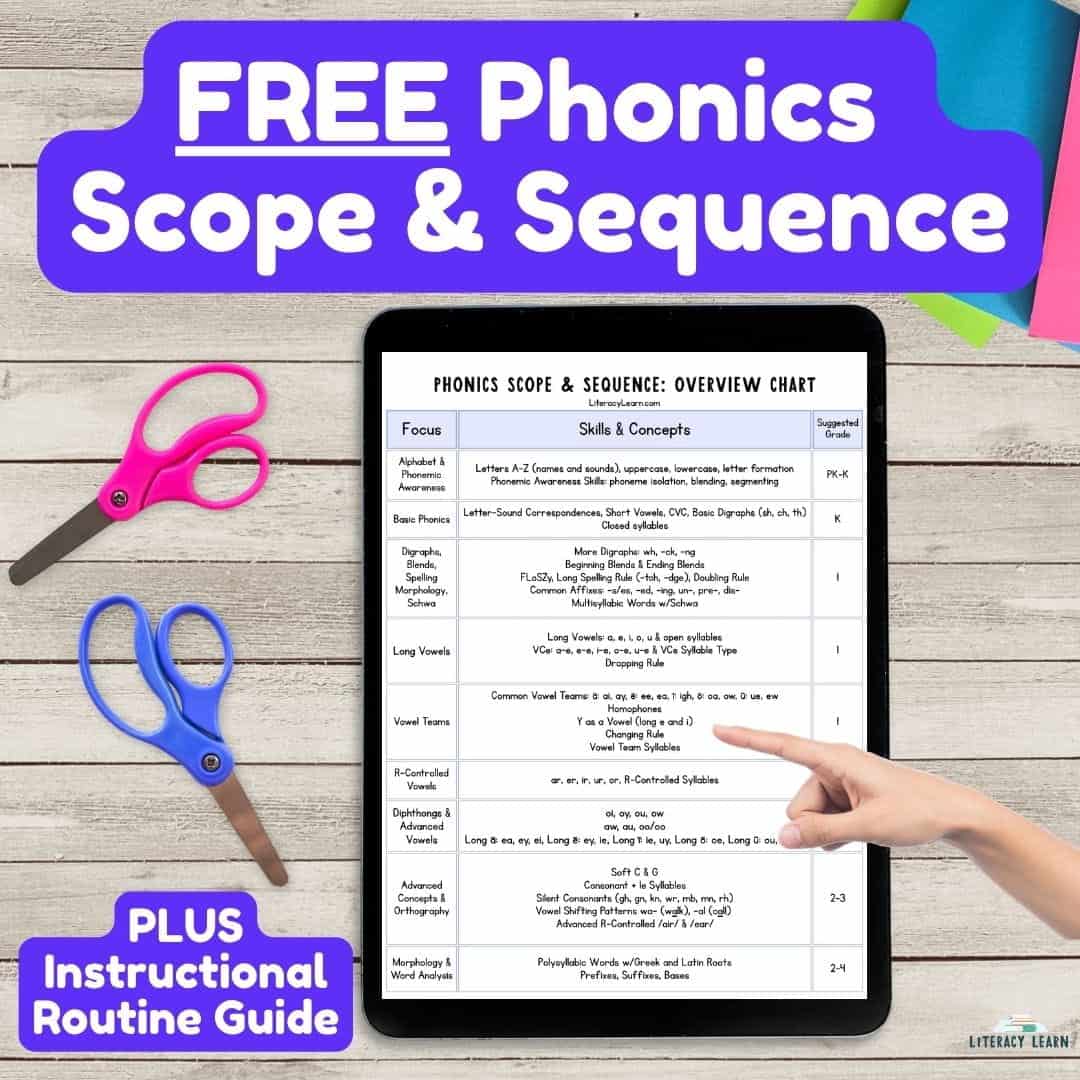
Teachers need to know in what order to teach phonics skills! Get this free Orton-Gillingham aligned scope and sequence to help you teach in a way that’s easy, makes sense, and is aligned with the research!
What Is a Phonics Scope & Sequence?
In literacy instruction, a scope and sequence is a resource that shows what skills students need to learn and the order to teach them. Everything is laid out in a very clear, step-by-step way, with easier skills taught first and progressing to more complex skills.
➡ A scope and sequence helps teachers know what to teach and when to teach it!
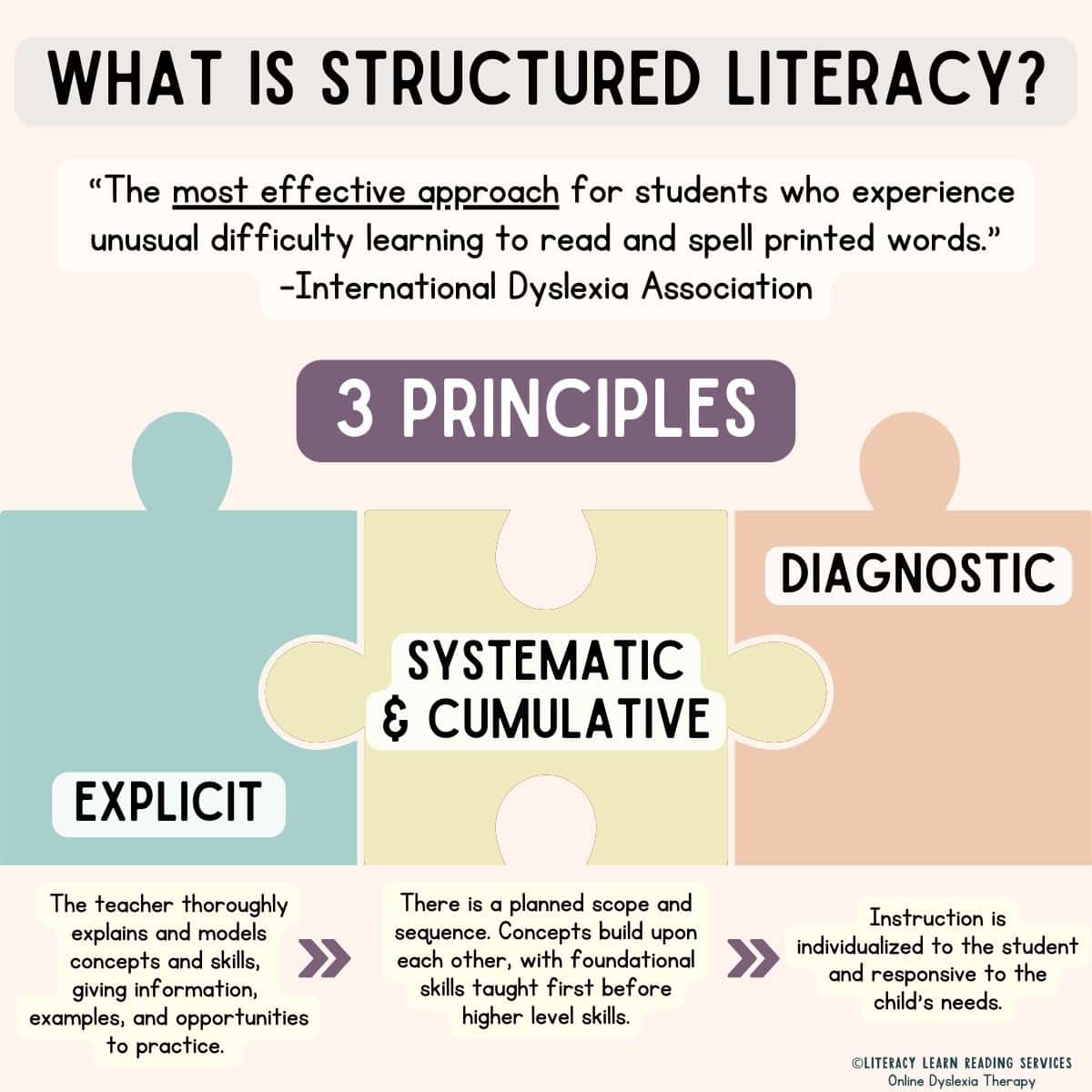
It helps ensure that instruction is both systematic and cumulative, two essential principles of structured literacy, according to the International Dyslexia Association.
👉🏼 Systematic means you teach in a planned order, starting with the basics before moving on to more advanced concepts. It’s following a “system” for teaching.
A good analogy for systematic instruction is a blueprint or a roadmap. It shows us exactly where we’re going and the path we need to follow to get there.
👉🏼 Cumulative means students learn new skills while continuing to practice what they’ve already learned. They revisit concepts over time, which helps build deep understanding and leads to mastery.
Benefits of Using a Scope & Sequence
Using a strong Orton-Gillingham aligned scope and sequence helps ensure reading is taught in a structured, more effective way. Here’s how:
- It ensures that instruction follows a clear, structured approach.
- Nothing gets left out. All skills are included in an order that makes sense!
- It keeps the teacher and students on track, and it helps students build their skills step-by-step.
- Saves planning time and builds teachers’ confidence.
“When a specific instructional sequence exists, you usually see more teaching than when it is left up to each teacher to work this out herself; and that is a big benefit for kids.” -Timothy Shanahan
You’ll find that a research-backed scope and sequence like this one is a very practical tool for teaching reading!
Free Scope & Sequence Chart
This free resource gives you a clear roadmap for teaching phonics skills in a logical order.
It follows a systematic and cumulative progression, helping you understand how to move from basic skills like letter sounds and CVC words to more advanced concepts like vowel teams, syllable types, and morphology.
Note: The chart below includes links to categories and resources on the blog that you might find helpful.
| Focus | Skills & Concepts | Grade Level |
| Alphabet | Letters A-Z (names and sounds), uppercase, lowercase, letter formation Phonemic Awareness Skills: phoneme isolation, blending, segmenting | Pre-k & Kindergarten |
| Phonics Basics | Letter-Sound Correspondences, Short Vowels, CVC, Basic Digraphs, (sh, ch, th) Closed syllables | Kindergarten (Review in 1st) |
| Digraphs Blends Spelling Morphology Schwa | More Digraphs: wh, -ck, -ng Beginning Blends & Ending Blends Floss, Long Spelling Rule (-tch, -dge), Doubling Rule Common Affixes: -s/es, -ed, -ing, un-, pre-, dis- Multisyllabic Words w/Schwa | First Grade (Review in 2nd) |
| Long Vowels | Long Vowels: a, e, i, o, u & Open Syllables VCe: a-e, e-e, i-e, o-e, u-e & VCe Syllable Type Dropping Rule | First Grade (Review in 2nd) |
| Vowel Teams | Common Vowel Teams: ā: ai, ay, ē: ee, ea, ī: igh, ō: oa, ow, ū: ue, ew Homophones Y as a Vowel (long e and i) Changing Rule Vowel Team Syllables | First Grade (Review in 2nd & 3rd) |
| R-Controlled | ar, er, ir, ur, or, R-Controlled Syllables | First & Second (Review in 3rd) |
| Diphthongs & Advanced Vowels | oi/oy, ou/ow aw/au, oo/oo Long ā: ea, ey, ei, Long ē: ey, ie, Long ī: ie, uy, Long ō: oe, Long ū: ou, ue, ui | Second (Review in 3rd) |
| Advanced Concepts & Orthography | Soft C & G Consonant + le Syllables Silent Consonants (gh, gn, kn, wr, mb, mn, rh) Vowel Shifting Patterns wa- (walk), -al (call) Advanced R-Controlled /air/ & /ear/ | Second & Third (Review in 3rd & 4th) |
| Morphology & Word Analysis | Polysyllabic Words w/Greek and Latin Roots Prefixes, Suffixes, Bases | Second, Third, & Fourth |
🖨 Download a printable version of this chart (plus an instructional guide) at the bottom of this post!
How to Use this Scope & Sequence
This scope and sequence is intended to be a big-picture roadmap, not a week-by-week plan.
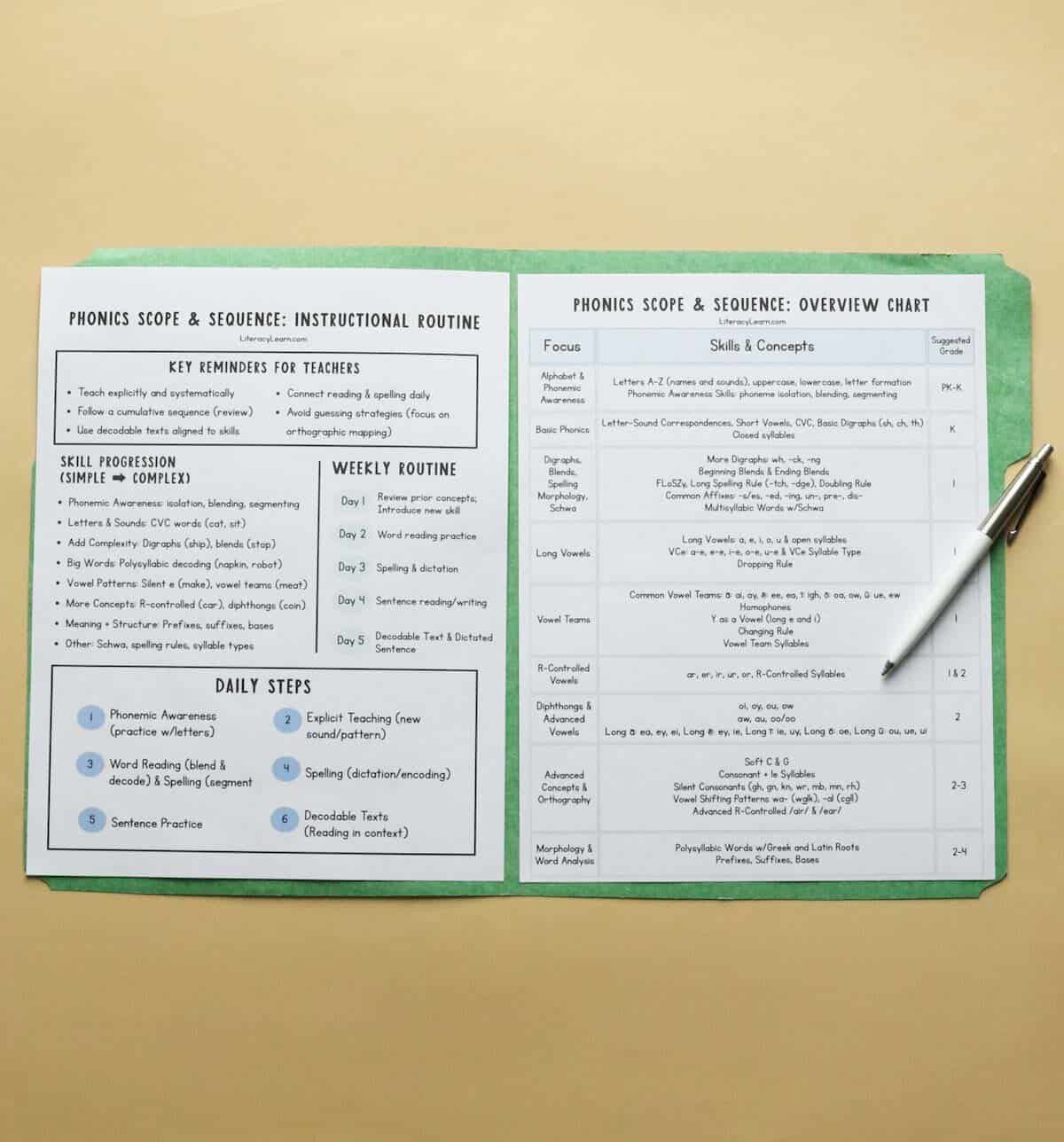
It shows the general order of skills, but each section should be broken down further based on your evidence-based curriculum and your students’ needs. Think of it as more of a scope than a detailed sequence.
For example, the “Alphabet” category might look simple, but it will take months (or longer) to teach this. Teachers need to explicitly and systematically teach all 26 letters of the alphabet, starting in pre-k and continuing through all of kindergarten.
Different curricula will teach the letters in a different order, and that’s okay. The order of the alphabet doesn’t really matter. But research does give us some helpful guidelines.
For example, we don’t teach easily confused letters like b and d close together; instead, we space them out to reduce confusion. It’s also helpful to introduce a few vowels and consonants early, so that kids can begin blending sounds to read simple words.
Think of this resource as your guide for what to teach when (in general), while your specific curriculum provides the specific lessons, pacing, and daily instruction.
The most important thing is to make sure your curriculum is evidence-based and includes all essential components of structured literacy. We suggest reviewing the Curriculum Navigation Reports from The Reading League to support your instructional decisions.
🧠 Learn More
Here are some helpful resources to dive deeper:
- Scope & Sequence: Iowa Reading Research Center
- Scope & Sequence for Literacy Instruction
- On Sequences of Instruction: Shanahan on Literacy
- Gibson, E. J., & Levin, H. (1975). The psychology of reading. The MIT Press. Retrieved from: https://psycnet.apa.org/record/1975-27205-000
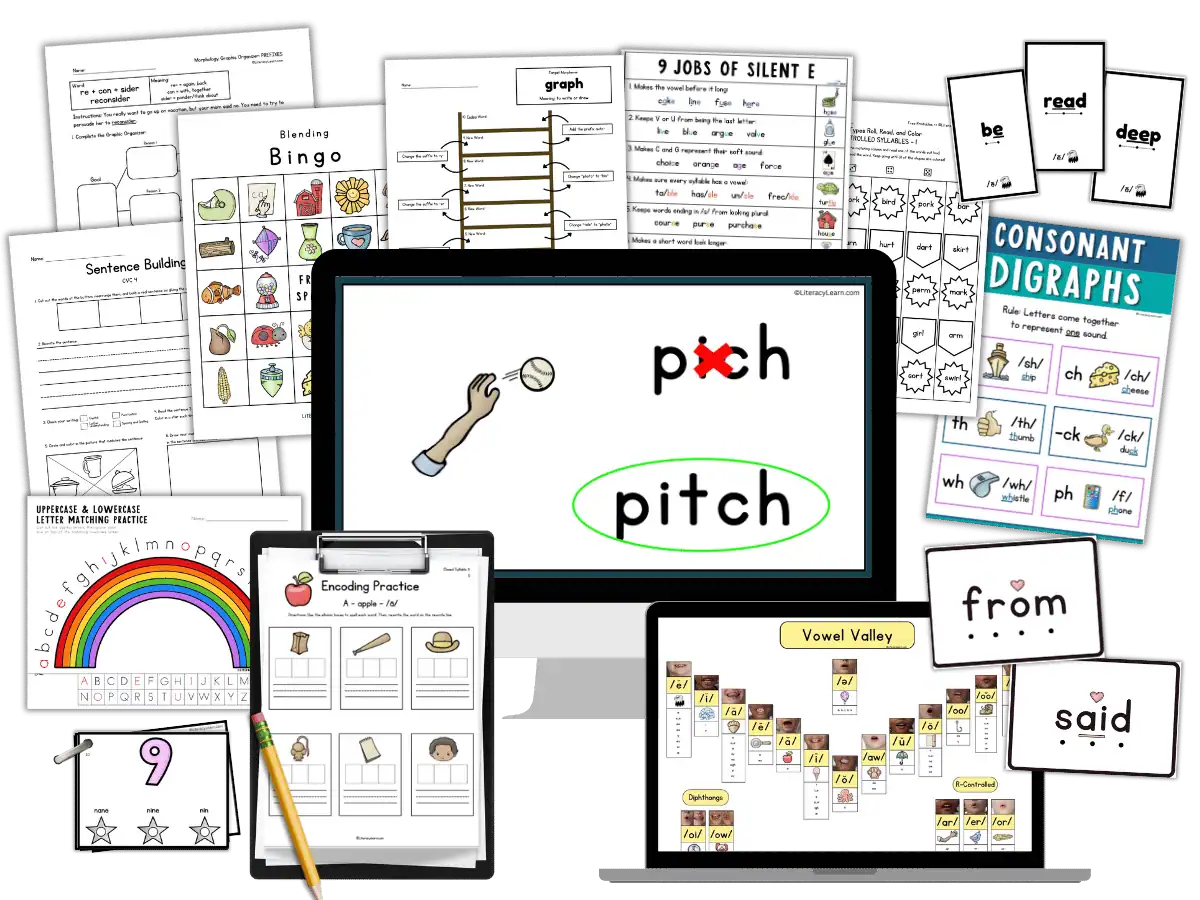
➡ Get more support with phonics instruction and the Science of Reading!
Inside LL Unlimited, you’ll find ready-to-use, classroom-friendly resources to help you teach the skills in this scope and sequence—plus full access to our TPT resource library (a $500+ value).
🖨 Download & Print

DOWNLOAD TERMS: All of our resources and printables are designed for personal use only in homes and classrooms. Each teacher must download his or her own copy. You may not: Save our files to a shared drive, reproduce our resources on the web, or make photocopies for anyone besides your own students. To share with others, please use the social share links provided or distribute the link to the blog post so others can download their own copies. Your support in this allows us to keep making free resources for everyone! Please see our Creative Credits page for information about the licensed clipart we use. If you have any questions or concerns regarding our terms, please email us. Thank you!